STMicroelectronics (ST) is the undisputed backbone of the industrial and automotive semiconductor markets. From the globally dominant STM32 microcontrollers to specialized power management ICs, ST components are integrated into everything from electric vehicle (EV) controllers to smart factory automation.
However, this high level of integration creates a massive risk for manufacturers when a part is declared Obsolete or reaches End-of-Life (EOL).
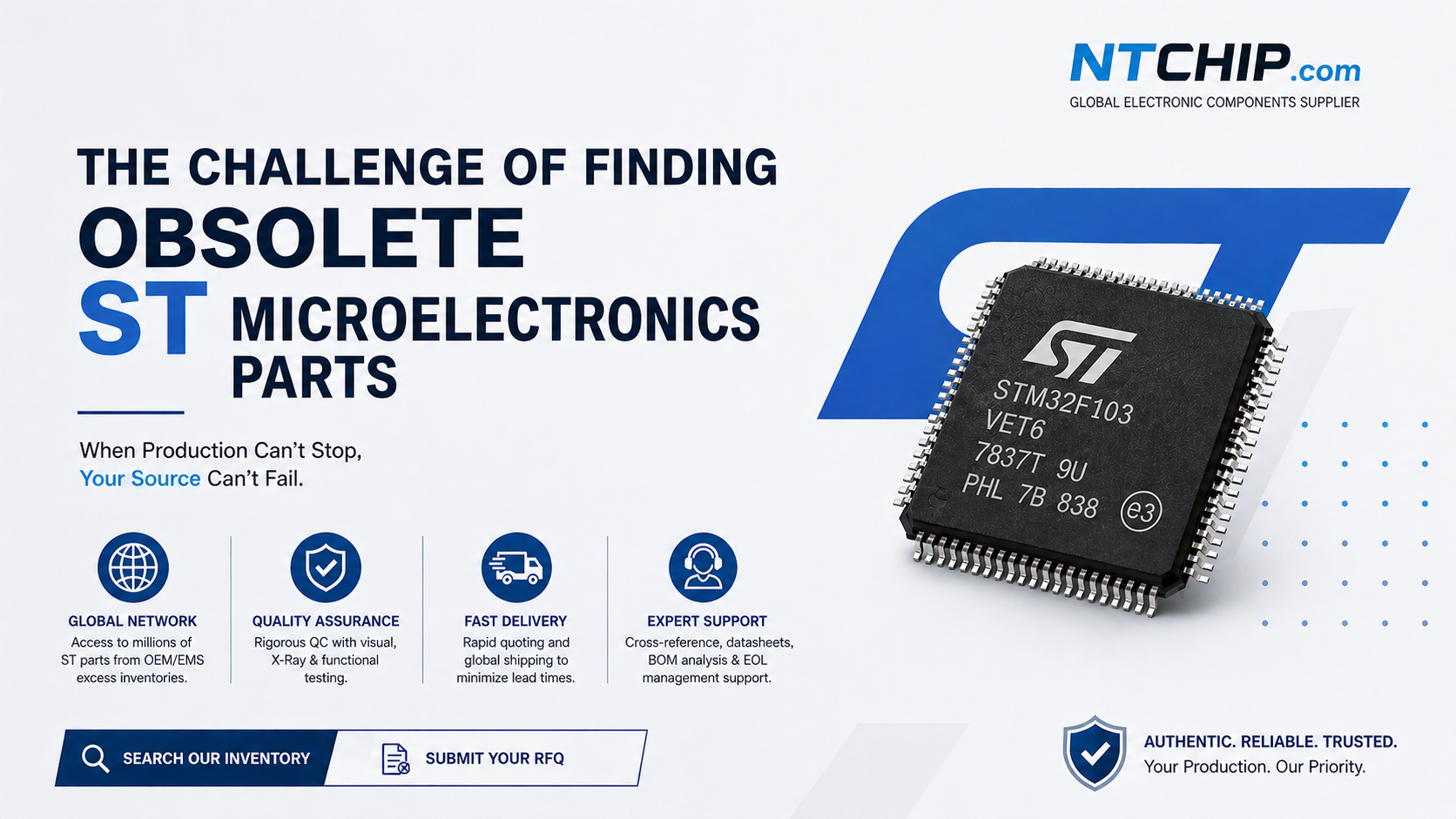
Why ST Discontinuations Are a "Fatal Blow" to Production
In the B2B world, replacing a chip isn't as simple as swapping a battery. When a critical ST microcontroller is no longer available, the impact is often catastrophic:
Fixed Design Ecosystems: Most industrial and automotive PCBAs are built specifically around the ST architecture. A single discontinued MCU can render an entire board design useless.
The Redesign Nightmare: If the original part cannot be sourced, companies are forced into a full "Board Redesign." This involves months of engineering work, software porting, and—most critically—expensive industry recertifications (such as CE, UL, or automotive safety standards).
Costly Downtime: Every day a production line waits for a hard-to-find ST part is a day of lost revenue. The "spot market" for these parts moves fast, and without a reliable partner, buyers often find themselves facing astronomical prices or, worse, counterfeit risks.
For any manufacturer relying on legacy ST hardware, managing obsolete STMicroelectronics components is no longer a choice—it is a necessity for survival.
Common STMicroelectronics Components That Go Obsolete
Not all components are created equal in the eyes of a manufacturer. STMicroelectronics manages a massive portfolio, and understanding which product families are most susceptible to obsolescence is key to proactive supply chain management. Typically, we see the highest frequency of EOL (End-of-Life) notices in three specific areas:
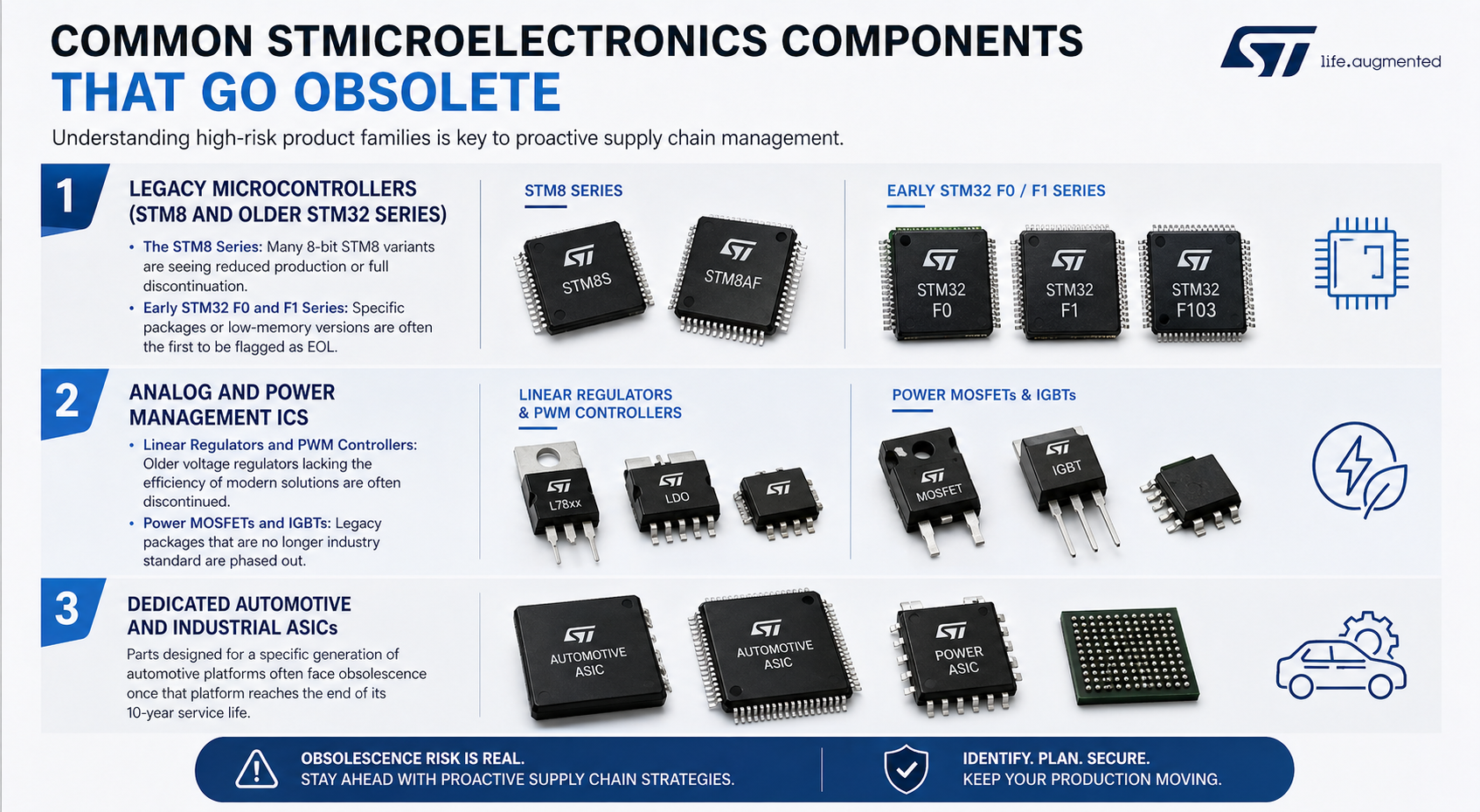
1. Legacy Microcontrollers (STM8 and older STM32 series)
While the STM32 family is still the industry standard, older iterations—particularly those built on larger nanometer process nodes—are frequently phased out.
The STM8 Series: As ST pushes more customers toward 32-bit architectures, many 8-bit STM8 variants are seeing reduced production or full discontinuation.
Early STM32 F0 and F1 Series: While still popular, certain specific packages or low-memory versions are often the first to be flagged when ST optimizes its production lines for newer series like the G0, U5, or H7.
2. Analog and Power Management ICs
ST is a leader in power semiconductors, but this field moves fast due to evolving energy efficiency standards (like RoHS or "Green" initiatives).
Linear Regulators and PWM Controllers: Older voltage regulators that lack the efficiency of modern switching regulators are common candidates for obsolescence.
Power MOSFETs and IGBTs: Specific legacy packages that are no longer "industry standard" are often discontinued in favor of smaller, more thermally efficient footprints.
3. Dedicated Automotive and Industrial ASICs
Parts designed for a specific generation of automotive platforms often face obsolescence once that platform reaches the end of its 10-year service life. Finding these "application-specific" chips is often the biggest challenge for repair and maintenance sectors.
Deciphering the "Early Warning" Signs: PCN and PDN
For a procurement manager, the most important documents aren't invoices—they are PCNs and PDNs. Understanding these is the difference between a smooth transition and a production crisis.
PCN (Product Change Notification): This is ST’s way of saying, "We are changing how we make this." It might be a new factory location or a change in the lead frame material. While the part isn't dead yet, a PCN often signals that the product is entering the later stages of its life cycle.
PDN (Product Discontinuance Notification): This is the "final countdown." A PDN provides the Last Time Buy (LTB) date and the Last Time Ship (LTS) date.
Pro Tip for Buyers: Once a PDN is issued for an ST component, the authorized market inventory usually evaporates within weeks. If you miss the "Last Time Buy" window, your only recourse is to partner with a trusted independent distributor like NTCHIP who has access to global buffer stocks.
Where to Find Hard-to-Find STMicroelectronics Chips?
When an ST component is marked as "Obsolete" on the manufacturer’s website, the traditional procurement route often hits a dead end. However, "Obsolete" at the factory level does not mean the stock has vanished from the planet. It simply means it has shifted from primary to secondary markets.
Authorized vs. Independent Distributors: Knowing the Difference
For most procurement teams, the first stop is always an Authorized Distributor (e.g., Arrow, Mouser, or Avnet). These are excellent partners for current-production, high-volume needs. But what happens when their systems show "Zero Stock" or "Factory EOL"?
Authorized Distributors: Their business model relies on a direct pipeline from ST’s factories. Once ST stops the machines, these distributors eventually clear their shelves and stop taking orders. They are bound by manufacturer agreements that limit their ability to source "old" stock from the open market.
Independent Distributors (The NTCHIP Advantage): As a leading independent distributor, NTCHIP operates without these rigid constraints. When the authorized channel says "No," we look further. Our advantage lies in:
Market Agility: We can source from global buffer stocks that authorized players cannot access.
Focus on Discontinued Lines: We specialize in the "Hard-to-Find" niche, maintaining a database of ST parts that have been out of production for years.
Small to Mid-Volume Support: While factories require massive Minimum Order Quantities (MOQs), we can provide the exact amount needed to finish your production run.
Tapping into Global Excess Inventory Networks
One of the best-kept secrets in the electronics industry is Excess Inventory. Millions of original STMicroelectronics chips are sitting in climate-controlled warehouses owned by OEMs (Original Equipment Manufacturers) and EMS (Electronic Manufacturing Services) providers worldwide.
Why does this stock exist?
Project Cancellations: A manufacturer may have bought 10,000 STM32F4 chips for a project that was later downsized.
BOM Over-Ordering: To prevent shortages, companies often over-buy, leaving "dead stock" once the product lifecycle ends.
Strategic Buffering: Some large-scale manufacturers keep "Safety Stock" that they eventually release back into the market.
How NTCHIP leverages this: We have built a proprietary global network that tracks this "surplus" stock. When you send us an RFQ for a discontinued ST part, we aren't just checking a shelf; we are scanning thousands of vetted OEM warehouses across Asia, Europe, and North America. This allows us to find factory-sealed, original ST parts that are no longer available anywhere else.
Identifying Authentic STMicroelectronics Components: How to Spot the Fakes
In the high-stakes world of obsolete sourcing, scarcity often invites risk. When an ST chip is no longer available through authorized channels, the "open market" becomes a magnet for counterfeiters.
At NTCHIP, we believe that trust is built on verification. To protect your production line, our quality control engineers focus on several "localized" industry standards to identify authentic STMicroelectronics parts.
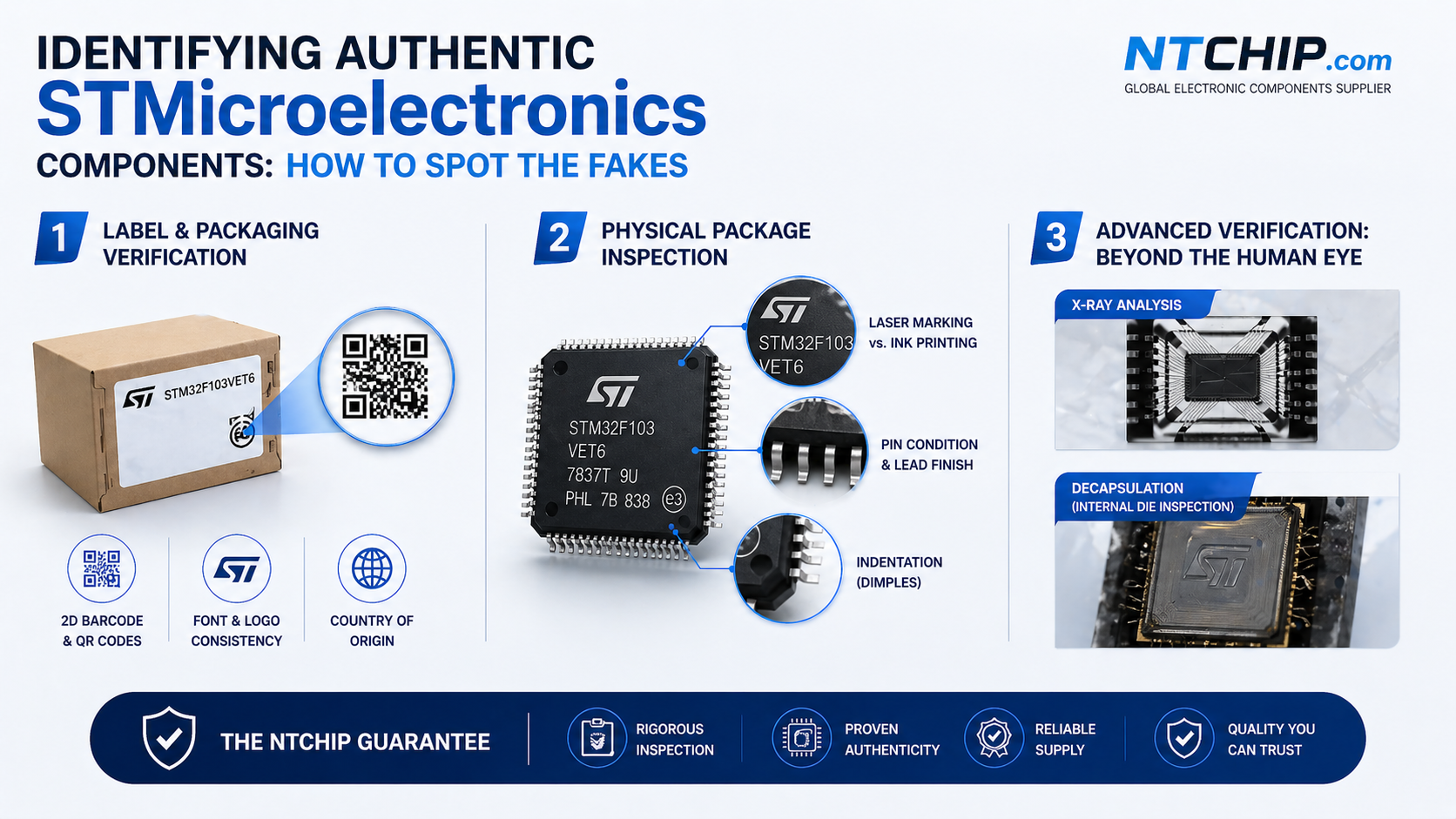
Label and Packaging Verification (Traceability)
The first line of defense is the outer labeling. STMicroelectronics has a very specific "visual language" for its packaging that counterfeiters often fail to replicate perfectly.
The 2D Barcode & QR Codes: Modern ST labels use high-density 2D barcodes. These should be crisp, scannable, and contain encoded data that matches the human-readable text (Lot code, Date code, and Part number).
Font and Logo Consistency: Authentic ST labels use a proprietary font. We look for "bleeding" ink, irregular spacing, or slightly off-color logos which are immediate red flags of a relabeled box.
Country of Origin (COO): We cross-reference the COO with known ST manufacturing sites (e.g., Malaysia, Malta, China, or Singapore) for that specific product family.
Physical Package Inspection (The "Micro" Details)
Once the box is open, we move to the component level. Counterfeiters often "blacktop" old chips—sanding off the original markings and printing new ones.
Laser Marking vs. Ink Printing: Authentic STMicroelectronics ICs, especially the STM32 series, use precision laser etching. The markings should be uniform in depth and color. If the text looks like it’s "sitting on top" of the plastic or can be wiped away with acetone, it’s a fake.
Pin Condition and Lead Finish: Genuine, unused (New Original) parts have pristine, uniform pins with no signs of oxidation, scratches, or "re-tinning" (where pins are dipped in solder to look new).
The Indentation (Dimples): ST’s molds have specific circular indentations on the bottom or corners of the chip. Counterfeiters often fill these in during the "blacktopping" process.
Advanced Verification: Beyond the Human Eye
For high-reliability sectors like automotive or medical, visual inspection isn't enough. This is where NTCHIP’s technical expertise comes in:
X-Ray Analysis: We use X-ray to ensure the internal die size and wire bonding match the manufacturer’s "Golden Sample."
Decapsulation (Internal Die Inspection): In critical cases, we "decap" a sample to reveal the ST logo and part number etched directly onto the silicon wafer itself—the ultimate proof of authenticity.
The NTCHIP Guarantee: We don’t just "find" parts; we validate them. Every ST component that passes through our facility undergoes a multi-step inspection process to ensure that your "obsolete" solution is a "genuine" solution.
Managing STMicroelectronics EOL: Cross-Reference & Alternatives
In the electronics industry, "Obsolete" doesn't always mean "Game Over." If you cannot find the exact STMicroelectronics part number on your BOM, there are three primary strategies we recommend to our clients to keep their lines running.
1. Pin-to-Pin (Drop-in) Replacements
The ideal scenario is finding a Pin-to-Pin compatible alternative. STMicroelectronics often designs its chip families with migration paths in mind. For example, many members of the STM32 F1, F2, and F4 series share the same footprint (LQFP64, LQFP100, etc.) and power configurations.
Same Family Upgrades: Sometimes, a version of the same chip with more Flash memory or a higher clock speed is still in production and can be used as a direct replacement with minimal risk.
Alternative Brands: In some cases, other manufacturers (like GigaDevice or Artery) produce "clones" or highly compatible alternatives to popular ST MCUs. However, these require rigorous testing before implementation.
2. Key Parameters to Verify
When evaluating an alternative for a discontinued ST part, our engineering team focuses on these critical specifications:
Voltage Levels (VCC/VDD): Does the alternative operate within the same 1.8V, 3.3V, or 5V range?
Peripheral Mapping: Does the replacement have the same number of UART, SPI, and I2C channels on the same physical pins?
Thermal Performance: Is the power dissipation and operating temperature range (Industrial vs. Commercial) a match for your environment?
Package Dimensions: Even if the pin count is the same, verify the "Pitch" and "Land Pattern" to ensure it fits your existing PCB.
3. Software and Firmware Compatibility
This is the "hidden" challenge of obsolescence management. Even if a chip is hardware-compatible, the Firmware may need adjustments.
HAL and LL Libraries: If you are using ST’s Hardware Abstraction Layer (HAL), moving between different STM32 series might be relatively simple.
Timing-Sensitive Code: If your code relies on specific internal clock cycles or legacy registers, a "compatible" chip might behave differently, requiring a firmware patch.
Why Partner with NTCHIP for ST Alternatives?
Finding a replacement is easy; finding the right replacement that won't fail in the field is hard. At NTCHIP, we go beyond just "selling parts." We provide technical support to help you navigate the EOL landscape:
Datasheet Comparison: We can provide detailed comparisons between your obsolete ST part and potential candidates.
Sample Sourcing: We can help you source small quantities of alternative chips for your engineering team to perform "Proof of Concept" (PoC) testing.
BOM Health Analysis: Send us your full BOM, and we will identify which ST parts are "High Risk" for future obsolescence, helping you plan your next redesign before the crisis hits.
Conclusion: Secure Your Supply Chain with Reliable STMicroelectronics Sourcing
Navigating the obsolescence of STMicroelectronics components is one of the most challenging aspects of modern electronics procurement. As we have explored, the risks of production downtime and counterfeit infiltration are real, but they are not insurmountable.
Whether you are facing a sudden STM32 shortage or managing a long-term legacy product, the key is to move from a reactive "panic buy" to a proactive sourcing strategy. By partnering with a vetted independent distributor, you gain access to a global safety net of inventory that authorized channels simply cannot provide.
Why Wait for a Line-Down Situation?
At NTCHIP, we don't just find parts; we secure your production's future. Our commitment to quality—backed by rigorous testing and a transparent supply chain—means you can source obsolete STMicroelectronics ICs with the same confidence as buying directly from the factory.
Our STMicroelectronics Sourcing Capabilities Include:
Real-time Access: A proprietary database of millions of ST parts from global OEM/EMS excess stocks.
Quality Assurance: Multi-step QC inspection including visual, X-ray, and functional testing.
Fast Turnaround: Rapid quoting and global shipping to minimize your lead times.
Technical Support: Expert advice on cross-referencing and EOL management.
Get a Quote for Your Obsolete ST Parts Today
Don't let a single discontinued chip shut down your entire assembly line. If you are struggling to find a specific STMicroelectronics microcontroller, power IC, or analog component, let our team of sourcing experts do the heavy lifting for you.
Ready to solve your shortage?
Search our inventory or Submit your RFQ here.
Upload your BOM: Have a list of multiple hard-to-find parts? Send us your spreadsheet for a comprehensive supply chain health check.
Talk to an Expert: Contact our sales team directly at [Insert Email/Phone] for immediate assistance.
Partner with NTCHIP—where quality meets reliability in the world of obsolete electronics.
Frequently Asked Questions (FAQ)
How can I check if an STMicroelectronics part is obsolete?
The most direct way is to visit the STMicroelectronics official website and enter the part number in their product search tool; active parts will be marked as "Production," while discontinued ones will show "EOL" or "Obsolete."
However, manufacturer websites don't always reflect real-time market availability. At NTCHIP, we recommend using our real-time part search database. We track official PCN (Product Change Notifications) and global inventory levels, providing you with a clearer picture of whether a part is truly gone or simply experiencing a temporary lead-time delay.
Why are some STM32 microcontrollers so hard to find?
The shortage and eventual obsolescence of certain STM32 MCUs are driven by three main factors:
Process Node Transitions: Semiconductor fabs are moving toward smaller, more efficient nanometer nodes. Older 8-bit and 32-bit legacy chips are often phased out to make room for high-margin, next-generation silicon.
Market Explosions: The rapid growth of the Automotive (EV) and IoT sectors has redirected the majority of ST’s production capacity.
Legacy Rationalization: ST periodically cleans up its massive portfolio to focus on series with higher energy efficiency and better security features, leading to the EOL of older "workhorse" models.
Does NTCHIP provide a warranty for obsolete ST parts?
Yes, absolutely. We understand that sourcing from the open market can be stressful. To provide our clients with peace of mind, NTCHIP offers a comprehensive 365-day warranty on all obsolete STMicroelectronics components.
Our confidence stems from our rigorous Quality Control (QC) process. Before any part reaches your facility, it undergoes multi-stage testing in our lab—including visual inspection, marking permanence tests, and advanced X-ray analysis—to ensure it meets original factory specifications.
Can I get a datasheet for a discontinued ST component?
Yes. When a part is discontinued, manufacturers often move the documentation to a "Legacy" or "Archive" section, making it difficult to find.
NTCHIP maintains an extensive library of historical datasheets for thousands of obsolete STMicroelectronics part numbers. Our technical team can provide these documents to your engineers, helping them verify electrical characteristics and evaluate potential pin-to-pin alternatives for your project.