The Dominance of Infineon IGBTs in Industrial Power
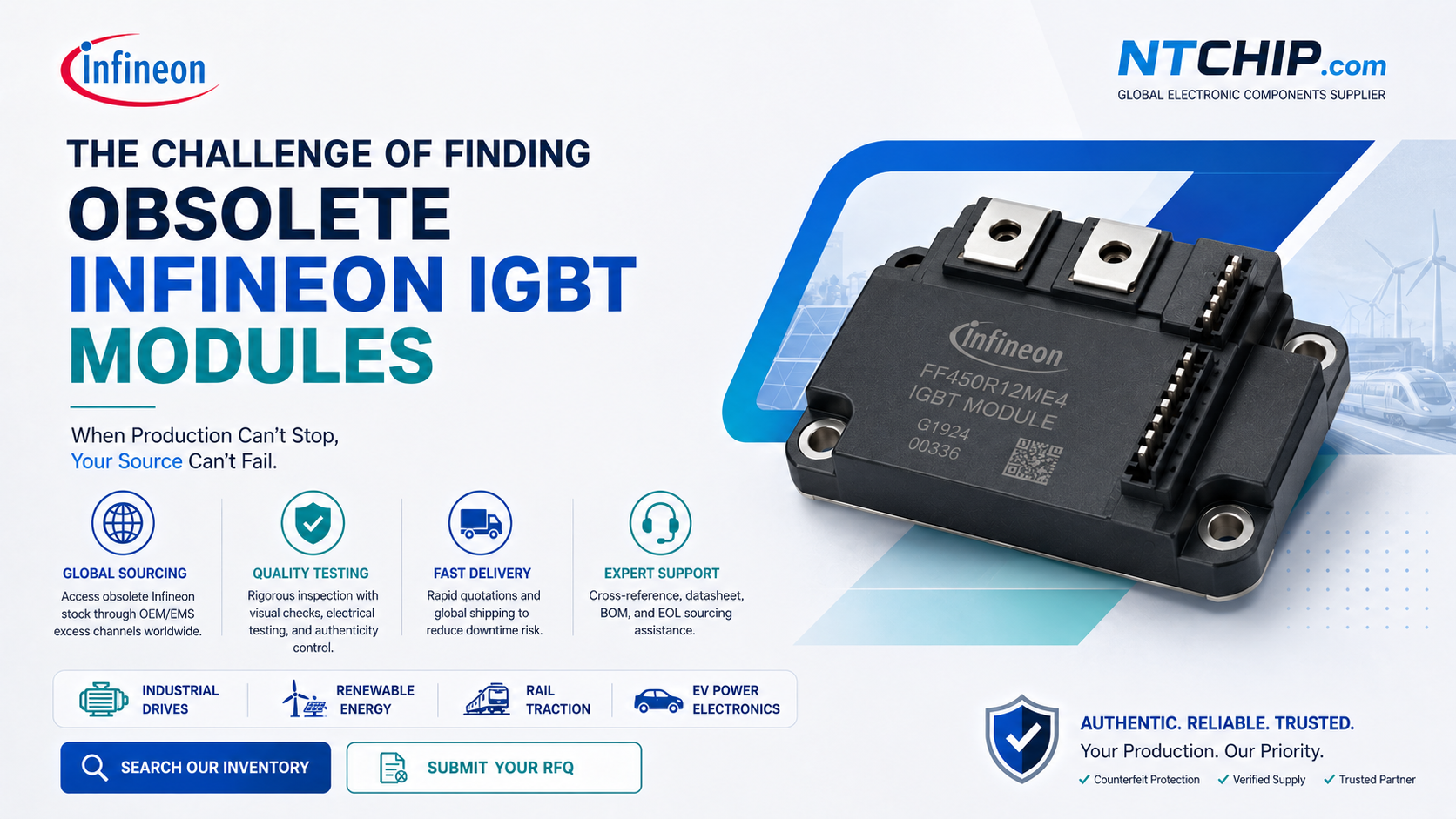
Infineon Technologies has long been the undisputed titan of the power semiconductor industry, consistently holding the largest market share in the global IGBT (Insulated Gate Bipolar Transistor) sector. For decades, Infineon IGBTs have set the gold standard for efficiency, power density, and reliability. This dominance is not merely a matter of production volume; it is rooted in their pioneering "Trenchstop?" and "Field Stop" technologies, which have revolutionized how energy is converted and controlled in high-stakes environments.
The ubiquity of Infineon components means they are the "heartbeat" of modern industrial infrastructure. Their vast product portfolio spans from discrete TRENCHSTOP? IGBTs to massive high-power modules used in:
Industrial Motor Drives & Inverters: Powering the factory automation and heavy machinery that drive global manufacturing.
Renewable Energy Systems: Acting as critical components in solar central inverters and wind turbine converters to ensure maximum energy yield with minimal loss.
Traction and Transportation: Reliability is non-negotiable in electric locomotives and high-speed trains, where Infineon modules handle extreme thermal cycles and high voltage loads daily.
Automotive EV Power Electronics: Leading the transition to sustainable mobility through high-performance power modules for electric vehicle drivetrains.
Because so many global systems are built specifically around the electrical characteristics of Infineon IGBT modules, when a specific part number reaches its End-of-Life (EOL), it creates a critical ripple effect across the entire supply chain.
Why Do Popular Infineon IGBTs Go Obsolete?
In the fast-paced semiconductor world, obsolescence is rarely a sign of a "bad" product. On the contrary, most obsolete Infineon IGBTs were once industry workhorses. The decision to issue a Product Discontinuance Notification (PDN) is usually a strategic move by Infineon to reallocate manufacturing capacity toward higher-margin, more efficient technologies.
For a procurement manager, understanding these drivers is the first step in predicting which parts in your BOM (Bill of Materials) might be next on the chopping block.
Transition to Newer Trenchstop? Technologies
The primary driver of obsolescence at Infineon is the relentless pursuit of energy efficiency. Each new generation of IGBT technology—moving from the classic IGBT3 to IGBT4, and now the advanced IGBT7—aims to reduce power losses and increase power density.
Wafer Optimization: As Infineon moves production to highly advanced 300mm thin-wafer technology, older process nodes become economically "inefficient" for the fab to maintain.
Performance Gains: Newer Trenchstop? generations offer significantly lower collector-emitter saturation voltage ($V_{ce(sat)}$) and reduced switching losses.
The Cannibalization Effect: Once a new generation (like IGBT7) achieves mass production and price parity, Infineon will systematically phase out older generations (like IGBT3 or early IGBT4) to force the market toward the more efficient standard.
Phase-out of Older Packages (e.g., Early EconoPACK? or 62mm modules)

Sometimes it isn't the silicon chip inside that goes obsolete, but the "housing" it sits in. The mechanical footprint of an IGBT module is critical for heat sink compatibility and busbar alignment.
Standardization: Infineon pioneered iconic packages like the 62mm module and the EconoPACK? series. However, as industrial designs become more compact, older, bulkier package styles are being phased out in favor of high-density designs like PrimePACK? or EasyPIM?.
Manufacturing Line Costs: Maintaining specialized assembly lines for legacy packages is expensive. When the volume for a specific 62mm variant drops below a certain threshold, the line is decommissioned.
The Sourcing Trap: For a manufacturer with a 15-year-old inverter design, the EOL of a specific package is a "showstopper" because it often requires a total redesign of the mechanical cooling system.
Environmental Compliance & Material Changes
Global regulations play a massive "invisible" role in component obsolescence. What was a compliant part ten years ago may no longer meet today's "Green" standards.
RoHS and REACH Updates: Changes in the "Restriction of Hazardous Substances" (RoHS) or REACH regulations often target specific lead-based solders or flame retardants used in older module encasements.
The Cost of "Going Green": If the cost to re-engineer an old, low-volume IGBT module to be "lead-free" or "halogen-free" outweighs its projected future sales, Infineon will simply issue a PDN.
Material Scarcity: If a sub-supplier for a specific specialized resin or ceramic substrate stops production, it can force an entire line of Infineon modules into early retirement.
The Risks of Sourcing Discontinued Infineon IGBTs
In the high-power electronics industry, sourcing a component is only half the battle; ensuring its reliability is where the true challenge lies. Unlike small signal transistors, a failure in an Infineon IGBT module isn't just a "dead component"—it often results in a catastrophic "explosion" (thermal runaway) that can destroy an entire inverter stack, cause weeks of downtime, and pose significant safety risks to personnel.
When you step outside the authorized channel to source discontinued Infineon IGBTs, you enter a complex "open market" where the following three risks become your primary obstacles.
Counterfeit & Refurbished Modules (The "New-Looking" Trap)
The high resale value of Infineon’s 62mm, EconoPACK?, and PrimePACK? modules makes them prime targets for sophisticated counterfeiters. We often categorize these risks into two levels:
Aesthetic Manipulation (Blacktopping): Counterfeiters take used or defective modules, sandblast the original surface, and apply a new chemical coating (blacktopping). They then use high-precision lasers to etch fake "New" date codes and part numbers.
The "Hybrid" Fraud: A more dangerous practice involves taking an authentic Infineon housing but placing lower-grade or salvaged silicon dies inside. These modules may pass basic multimeter tests but will fail instantly under full load or high-frequency switching due to incorrect $V_{ce(sat)}$ (saturation voltage) or poor thermal conductivity.
Improper Storage & Lead Oxidation (The "Invisible" Damage)
Even if a module is 100% original, its "shelf life" is dictated by how it was stored over the years. Obsolete parts have often changed hands multiple times, leading to several environmental risks:
Lead Oxidation: If not stored in a nitrogen-sealed environment, the power terminals and signal pins develop a layer of oxidation. This leads to poor solderability or high contact resistance, which generates localized heat and eventually melts the terminal connections.
Moisture Ingress & Delamination: Power modules are sensitive to humidity. If the internal gel or ceramic substrate absorbs moisture, the "Popcorn Effect" can occur during the heat of operation, causing internal delamination and catastrophic isolation failure.
ESD (Electrostatic Discharge): Many independent brokers handle IGBTs without proper ESD-safe protocols. A single static discharge can weaken the gate oxide layer, creating a "latent defect" that functions for a few days before failing in the field.
Lack of Technical Support and Factory Warranty
The final risk is the total loss of the "Infineon Safety Net." When a part is officially obsolete and purchased through the open market:
No Factory Recourse: Infineon will not provide Failure Analysis (FA) reports or technical application support for parts sourced outside authorized channels.
Warranty Voidance: Most brokers operate on a "test-and-ship" basis with no long-term liability. If the part fails six months later due to a latent defect, the financial burden of the equipment repair falls entirely on the buyer.
Pro Tip: This is why choosing a distributor with a 365-day warranty and an in-house laboratory is non-negotiable for obsolete power semiconductors.
How to Identify a Reliable Infineon Obsolete IGBT Distributor
Sourcing obsolete Infineon IGBTs requires moving beyond simple price comparisons. In the open market, "too good to be true" prices often hide significant quality risks. A reliable distributor acts as your technical gatekeeper, filtering out high-risk components before they ever reach your facility.
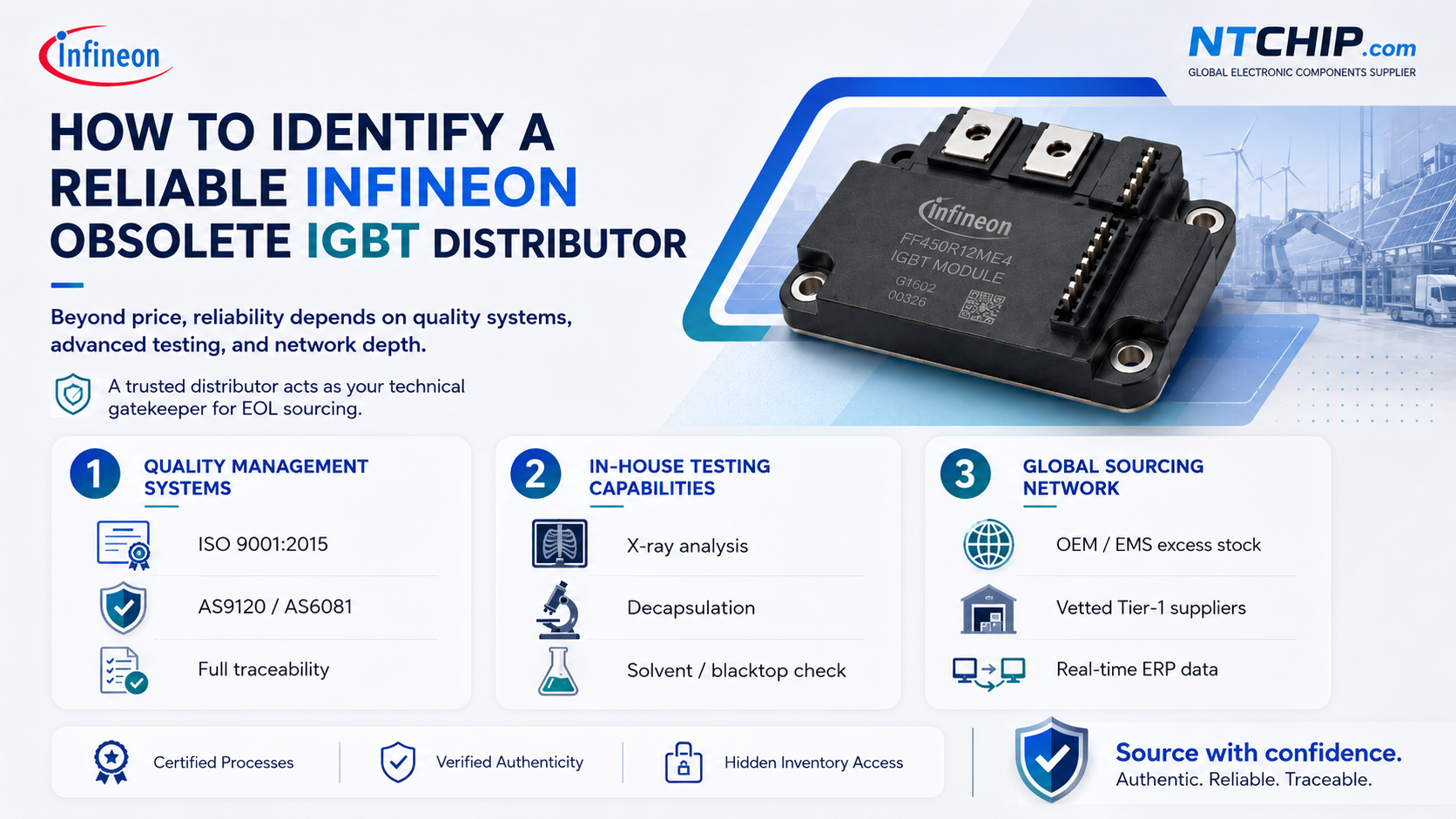
When evaluating a potential partner for your EOL (End-of-Life) requirements, look for these three non-negotiable pillars of reliability.
1. Quality Management Systems (ISO & Industry Certifications)
A distributor’s commitment to quality is only as strong as the systems that govern it. Formal certifications are the baseline for professional operations:
ISO 9001:2015: This ensures that the distributor has a documented process for everything from vendor vetting to order fulfillment.
AS9120 / AS6081 (Aerospace Standards): While specific to aerospace, distributors following these standards have the most rigorous protocols for avoiding, detecting, and reporting counterfeit electronic components.
Full Traceability: A reliable distributor maintains a clear "paper trail." Even for discontinued Infineon IGBT modules, they should be able to provide documentation that traces the parts back to the original manufacturer or a verified OEM excess stock.
2. In-house Testing Capabilities (Beyond Visual Inspection)
You cannot verify a power module simply by looking at the box. Because Infineon modules are frequently targetted for "blacktopping" and "refurbishing," a distributor must have internal or third-party laboratory access to perform advanced testing:
X-Ray Analysis: This is the gold standard for checking the internal consistency of the module. X-ray imaging reveals if the internal wire bonds and silicon dies match the factory-original configuration across the entire batch.
Decapsulation (Internal Die Verification): By removing the outer casing of a sample, engineers can inspect the silicon die directly. For original Infineon parts, the "Infineon" logo or a specific die-code will be etched onto the wafer itself—a detail counterfeiters rarely get right.
Acetone/Resistance-to-Solvents Testing: This simple yet effective test determines if the top marking has been "blacktopped" or reprinted to hide an older date code.
3. Global Sourcing Network (OEM/EMS Excess Stock)
Why does an independent distributor have stock that the factory doesn't? The answer lies in their network depth. A top-tier Infineon IGBT distributor doesn't just scan public databases; they have direct access to "hidden" inventory:
OEM/EMS Excess Management: When a major manufacturer (like a wind turbine or industrial drive maker) cancels a project or updates their design, they often have thousands of high-quality, factory-original Infineon parts sitting in climate-controlled warehouses.
Vetted Tier-1 Suppliers: A reliable distributor has a "white-list" of global partners built over decades. They prioritize sourcing from other ISO-certified entities and avoid "shadowy" brokers with no physical location or testing history.
Real-Time Data: They use advanced ERP systems to track the global movement of hard-to-find TI and Infineon chips, allowing them to secure inventory before it disappears from the market.
Technical Strategies: Redesign vs. Finding Original Stock
When a critical Infineon IGBT module is flagged as EOL (End-of-Life), engineering and procurement teams are often forced into a high-stakes debate: Should we redesign the entire power circuit to accommodate a newer component, or should we invest in finding original, obsolete stock?
In mission-critical industrial applications—such as high-speed rail traction, offshore wind inverters, or medical imaging—the "Redesign" route is often far more expensive and risky than it appears on paper.
The Hidden Costs of Redesigning Power Electronics
A "simple" component swap in power electronics is never simple. Replacing an obsolete Infineon module with a newer generation (e.g., swapping an IGBT3 for an IGBT7) involves significant hidden costs:
Mechanical & Thermal Re-engineering: Newer modules often have different footprints or thermal profiles. This may require redesigning expensive cold plates, heat sinks, and busbar alignments.
Gate Driver Recalibration: Different generations of Infineon silicon have different gate charge ($Q_g$) and switching characteristics. Using a newer part often requires a complete overhaul of the gate driver board to prevent switching instability or EMI issues.
Software & Firmware Updates: In digital-controlled power stacks, the control algorithms are tuned to the specific switching speeds of the original Infineon silicon. Changing the hardware may necessitate thousands of man-hours in firmware re-coding and validation.
The Regulatory & Certification Nightmare
For industries like Aerospace, Medical, and Automotive, a change in the Bill of Materials (BOM) isn't just a technical hurdle—it’s a legal one.
Recertification Costs: Any major change to the power stage can trigger a requirement for new EMI/EMC testing and safety certifications (UL, CE, TUV).
Industry Standards: In the medical sector, a redesign might require a new FDA filing. In the railway sector, EN 50155 compliance must be re-verified. These processes can take 6 to 18 months, during which your product cannot be sold.
Reliability Uncertainty: A new design introduces "infant mortality" risks. The original design has been field-proven for years; a redesign is an unproven variable.
Why Sourcing Original Stock is Often the Superior Strategy
For most legacy systems, finding original, obsolete Infineon IGBT stock through a trusted distributor is the most commercially viable path.
| Factor | Redesigning the System | Sourcing Original Stock |
|---|
| Time-to-Market | 6–18 Months (Slow) | 1–2 Weeks (Fast) |
| Upfront Cost | High (R&D + Tooling) | Moderate (Market Premium) |
| Validation Risk | High (New Design Failures) | Zero (Proven Hardware) |
| Certification | Requires Recertification | Maintains Existing Approval |
| Downtime | Extensive | Minimal |
The Verdict: When to Source vs. When to Redesign
While a redesign is eventually inevitable for products with another 20 years of planned life, sourcing original stock is the preferred strategy when:
The equipment is already deployed in the field and needs repair.
The cost of recertification exceeds the premium of the obsolete parts.
Production downtime is costing your company thousands of dollars per hour.
Expert Insight: By securing a strategic reserve of original Infineon IGBTs through NTCHIP, you buy your engineering team the one thing they need most: Time. Time to plan a controlled transition to new technology without stopping your current revenue stream.
How to Verify the Authenticity of Infineon IGBTs
In the high-power semiconductor market, relying on a supplier’s "promise" is a liability. To ensure that an obsolete Infineon IGBT will perform to original factory specifications, a rigorous, multi-layered verification protocol is essential. At NTCHIP, we move beyond basic visual checks to implement a laboratory-grade inspection process that filters out high-risk components before they reach your assembly line.
1. Top Marking & Label Inspection (Tracking Lot Codes)
The first line of defense is a forensic examination of the module’s exterior. Counterfeiters often sandblast original markings to "upgrade" an older or lower-spec part to a more expensive version.
Laser Etching Analysis: Original Infineon modules use high-precision laser etching. We inspect for uniform depth, consistent font kerning, and the absence of "ghosting"—a common sign of re-marking over a previous layer (blacktopping).
Lot Code & Date Code Traceability: Every authentic Infineon module carries a unique Lot Code. We verify these codes against Infineon’s historical manufacturing data. Inconsistencies—such as a Date Code that predates the introduction of a specific package style—are immediate red flags.
Solvent Testing: We perform "Resistance to Solvents" (RTS) testing using Acetone and specialized chemicals to ensure the surface hasn't been coated with resins designed to hide original markings or fraudulent re-prints.
2. Scanning Electron Microscopy (SEM) for Pin Analysis
When visual inspection reaches its limit, we employ Scanning Electron Microscopy (SEM). This allows our engineers to see what the human eye cannot: the microscopic state of the terminals and the silicon surface morphology.
Detecting "Pulls" and Re-tinning: SEM can identify microscopic residues of solder or "scratches" on the pins. If an IGBT is sold as "New Original" but shows signs of prior soldering or mechanical polishing on the leads, it is a refurbished part salvaged from old equipment.
Surface Consistency: We analyze the baseplate’s texture. Original Infineon modules have a specific metallic grain structure. SEM can detect if this surface has been mechanically altered to hide the wear and tear typically found on "used" modules.
3. Dynamic Electrical Testing (The Ultimate Performance Test)
The ultimate proof of authenticity is electrical performance. A counterfeit chip might look perfect under a microscope but will fail the moment it encounters high-frequency switching or high-voltage loads.
Measuring $V_{CE(sat)}$ (Saturation Voltage): We measure the collector-emitter saturation voltage at the rated current. Any significant deviation from the Infineon datasheet (typically in the range of $1.5V$ to $2.1V$ for many series) indicates an inferior or non-Infineon silicon die inside the housing.
Insulation & Dielectric Withstand Voltage: Using high-potential (Hi-Pot) testers, we verify the isolation between the terminals and the baseplate. Counterfeit parts often fail this, leading to catastrophic equipment grounding issues and safety hazards.
Thermal Imaging under Pulse Load: By applying a controlled pulse load, we use thermal cameras to ensure the heat distribution across the IGBT die is uniform, confirming that the internal wire bonding is intact and the thermal interface is factory-standard.
Top Infineon IGBT Series Often Found in the Obsolete Market
In the secondary market, demand is highest for Infineon IGBT modules that were industry standards for a decade or more. When these specific "workhorse" series reach EOL (End-of-Life), the resulting shortage can paralyze legacy industrial systems.
If you are managing a bill of materials (BOM) for older equipment, you are likely searching for one of the following high-demand obsolete series.
1. The IGBT3 (Generation 3) Series
Launched in the early 2000s, IGBT3 was the first generation to widely implement Trenchstop? technology. While Infineon has moved to IGBT7, many industrial drives still rely on the specific switching frequency and thermal profile of the 3rd generation.
Key Characteristics: Optimized for low $V_{ce(sat)}$ and high robustness.
Common Packages: Often found in 62mm modules and early EconoPACK? housings.
Sourcing Challenge: Genuine "New Original" IGBT3 chips are increasingly rare, as most factory lines have shifted to IGBT4 or newer.
2. Early IGBT4 (Generation 4) Legacy Modules
While IGBT4 is still widely used, the earliest versions and specific specialized configurations are already entering obsolescence.
Focus Areas: High-speed switching variants ($S4$) and medium-power industrial drives.
The Problem: Engineers often find that newer "Enhanced" IGBT4 modules have slightly different gate timings than the 15-year-old originals, making the obsolete versions highly sought after for direct repairs.
3. PrimePACK? 2 and PrimePACK? 3 (Early Versions)
The PrimePACK? series revolutionized high-power applications (wind power, traction). However, early versions of these modules (pre-dating the "PrimePACK? with .XT" technology) are now reaching the end of their lifecycle.
4. The 62mm Module Classics (Single and Dual)
The 62mm housing is perhaps the most iconic IGBT package in history. While the package style persists, many specific internal configurations (especially those with older silicon dies) are discontinued.
Common Series: FF200R, FF300R, and FF450R variants.
The Trap: Because the 62mm housing is so standard, this series is the most common victim of "refurbished" fraud, where used modules are cleaned and sold as new.
5. EconoPACK? 2 and EconoPACK? 3 (Legacy Designs)
For compact, integrated designs, the EconoPACK? series was the go-to solution for 15-100kW inverters.
Why Choose NTCHIP as Your Infineon Sourcing Partner?
Navigating the market for obsolete Infineon IGBTs is a high-stakes task. A single mistake in supplier selection can lead to catastrophic hardware failure. NTCHIP bridges the gap between the "unavailable" and the "reliable" by offering a procurement experience that mirrors authorized channels.
1. Professional Sourcing without the Risk
We leverage a global network of verified OEM and EMS excess stocks. We don't just "buy from brokers"; we source from climate-controlled industrial inventories where genuine Infineon modules have been stored correctly for years.
2. Our "Golden Standard" Testing Protocol
As detailed in our verification guide, every Infineon module passes through our in-house laboratory. From X-Ray internal inspection to Dynamic Electrical testing, we ensure that the "New Original" label on our parts is backed by scientific data.
3. Industry-Leading 365-Day Warranty
While the open market usually offers a "7-day return" policy (if any), NTCHIP provides a full one-year warranty. We have such confidence in our QC process that we take on the risk, allowing your engineering team to install our parts with absolute peace of mind.
4. Technical Expertise and Datasheet Support
Our team understands the nuances of Infineon's technology roadmap. If the exact obsolete part is nowhere to be found, our engineers can assist you in analyzing Cross-Reference options, ensuring that any alternative part meets the strict voltage, current, and timing requirements of your system.
Summary: Future-Proofing Your Infineon Component Supply
Texas Instruments and Infineon obsolescence is an inevitable part of the industrial lifecycle. However, it doesn't have to be a crisis. By partnering with a distributor that prioritizes traceability, advanced laboratory testing, and long-term warranty, you can extend the life of your critical equipment by years—if not decades.
Key Takeaways for Procurement Managers:
Act Early: Don't wait for the last module to fail. Identify "High Risk" EOL parts in your BOM now.
Verify Rigorously: Never accept a high-power module without a verified test report or a multi-month warranty.
Choose Experts: Work with a distributor like NTCHIP that specializes in power semiconductors and understands the technical stakes of your application.
FAQ Section
How can I verify if an Infineon IGBT module is officially obsolete?
Answer direction: Explain that the most reliable method is checking the Product Discontinuance Notification (PDN) list on the official Infineon website. For legacy parts, suggest consulting a specialized distributor like NTCHIP that maintains historical manufacturing databases and can verify status via specific Lot Codes.
Is it safe to buy discontinued IGBTs from independent distributors?
Answer direction: Clarify that it is safe only if the distributor has a verified quality management system. Mention that because these parts are sourced outside authorized channels, the distributor must perform laboratory inspections like X-Ray or Decapsulation to guarantee the parts are not refurbished or counterfeit.
What are the risks of using refurbished or pull IGBT modules?
Answer direction: Highlight the danger of thermal fatigue. Explain that modules pulled from used equipment have already undergone thousands of thermal cycles, weakening internal wire bonds. This often leads to catastrophic failure or explosions when re-installed in high-voltage industrial applications.
Can I replace an obsolete Infineon IGBT3 with a newer IGBT7 module?
Answer direction: Advise that it is rarely a drop-in replacement. While newer generations are more efficient, they have different gate charge requirements and switching speeds. A direct swap without recalibrating the gate driver circuit can lead to switching instability or electromagnetic interference issues.
Why do some obsolete Infineon IGBTs have much higher prices than new ones?
Answer direction: Attribute this to the basic laws of supply and demand in the open market. Explain that the premium reflects the scarcity of genuine new original stock and the high cost of production downtime if the specific part is not found.
How should obsolete IGBT modules be stored to prevent degradation?
Answer direction: Emphasize the need for moisture and oxidation control. Recommend storing legacy power modules in ESD-safe packaging within a climate-controlled environment, ideally in a nitrogen-filled dry cabinet to prevent terminal oxidation and internal delamination.