2SC5200 Transistor Overview
The 2SC5200 is a silicon NPN triple-diffused type power transistor designed and manufactured by Toshiba. Its core function is power amplification. According to the datasheet, its primary application is as the output stage for a 100-W high-fidelity audio amplifier. The transistor has a high collector-emitter voltage (VCEO) rating of 230 V, which provides sufficient voltage headroom to handle high-amplitude peaks in audio signals while maintaining stable operation.
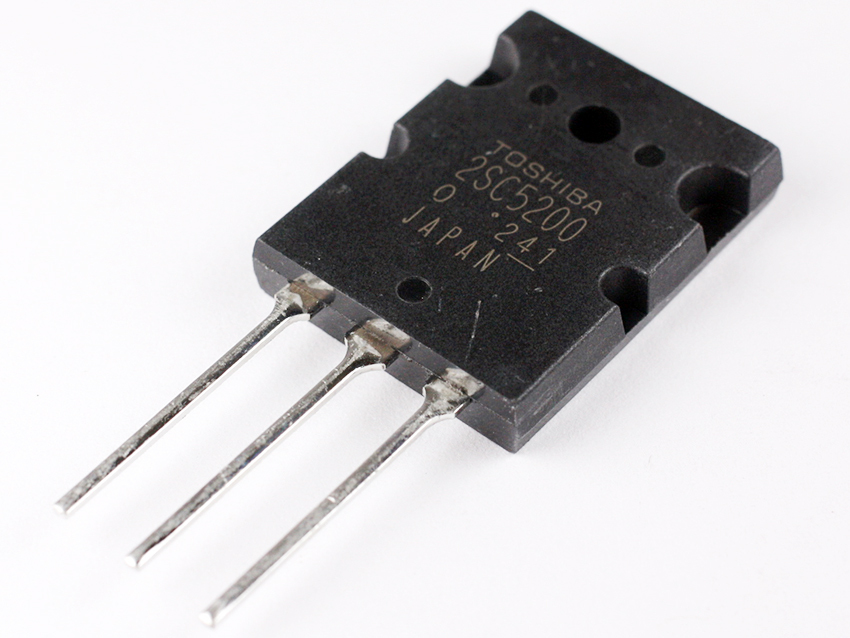
The Complementary Relationship with 2SA1943 and Its Design Intent
The design philosophy of this transistor is highlighted by its complementary relationship with another model, the 2SA1943. In power amplifier design, especially in the high-fidelity audio domain, it is common practice to use a push-pull output stage configuration. In this setup, a pair of matched NPN and PNP transistors is needed to amplify the positive and negative halves of the audio signal, respectively. The 2SC5200, as an NPN-type transistor, works in tandem with its complementary PNP-type transistor, the 2SA1943. This design approach, often referred to as Class-AB amplification, not only significantly boosts power output efficiency but also effectively reduces crossover distortion—the distortion that occurs when the signal crosses the zero point and the transistors are briefly turned off. Minimizing this distortion is crucial for achieving the "high-fidelity" sound quality mentioned in the datasheet. Therefore, the complementary relationship between the 2SC5200 and the 2SA1943 is not just product information; it reveals the core operating principle and design intent behind its high-performance audio circuit application.
Quick Reference Table for Key Performance Parameters
The table below summarizes the most important technical specifications of the 2SC5200 for quick reference and preliminary feasibility assessment.
| Parameter | Symbol | Rating/Typical Value | Unit |
|---|
| Collector-Emitter Voltage | VCEO | 230 | V |
| Collector Current | IC | 15 | A |
| Collector Power Dissipation | PC | 150 | W |
| DC Current Gain | hFE (Typ.) | 60 (IC=1 A) | - |
| Transition Frequency | fT (Typ.) | 30 | MHz |
Physical and Structural Characteristics
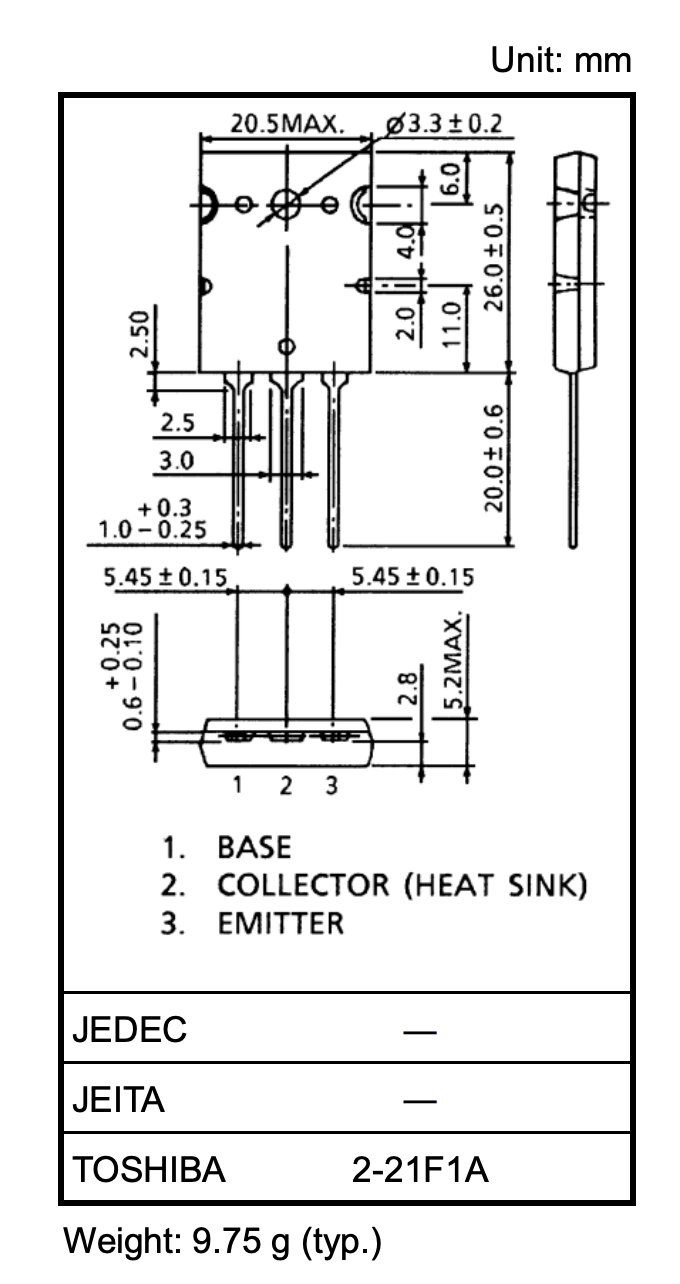
The 2SC5200 transistor is housed in the industry-standard TO-3P(N) package, a design that is critical to its thermal management. This large package, with typical dimensions of 20.5 mm in max width and 26.0 ± 0.5 mm in height, provides a substantial surface area. This is essential for effectively transferring the high heat generated during operation to an external heat sink. The transistor has a typical weight of 9.75 grams.
The pin configuration of the 2SC5200 follows the standard TO-3P layout. Pin 1 is the Base, Pin 3 is the Emitter, and Pin 2 serves as both the Collector and the metal flange (or heat sink). Integrating the collector with the heat sink is an efficient thermal conduction method that simplifies circuit layout. However, this design requires specific assembly considerations: when mounting the transistor to an external heat sink, you must ensure excellent thermal conduction while also maintaining a good electrical insulation between the collector and the heat sink. This is typically done using an insulator like a mica sheet or a silicone pad to prevent a short circuit and ensure safe operation.
2SC5200 Pinout
Combined Electrical and Thermal Characteristics Analysis
Absolute Maximum Ratings
The Absolute Maximum Ratings are the hard operating limits of the 2SC5200 transistor that must never be exceeded under any circumstances. Operating beyond these ratings, even for a very short duration, can cause permanent damage to the device. Here are its main ratings:
Collector-Base Voltage (VCBO): 230 V
Collector-Emitter Voltage (VCEO): 230 V
Emitter-Base Voltage (VEBO): 5 V
Collector Current (IC): 15 A
Base Current (IB): 1.5 A
Collector Power Dissipation (PC): 150 W (at a case temperature of 25°C)
Junction Temperature (Tj): 150°C
Storage Temperature Range (Tstg): -55 to 150°C
The datasheet specifically warns in a note: "Continuous usage under heavy loads (such as high temperature, high current, high voltage, and sharp temperature changes) even within the absolute maximum ratings may cause a significant decrease in product reliability." This means that simply staying within these hard boundaries is not enough to guarantee long-term reliability. Therefore, professional designers must follow the derating principle, setting the actual operating conditions well below these maximum ratings. This also shows that reliability engineering is a complex discipline separate from basic functionality, and a more comprehensive design requires consulting relevant reliability handbooks.
Electrical Characteristics
This section provides a detailed analysis of the 2SC5200's key static and dynamic parameters, which directly influence its performance in a circuit.
Collector-Emitter Breakdown Voltage (V(BR)CEO): A minimum of 230 V. This is the maximum voltage the transistor can withstand with an open base. It's crucial for high-voltage applications like high-power audio amplifiers, providing a sufficient voltage safety margin.
DC Current Gain (hFE): At VCE=5 V and IC=1 A, the typical value is 60, with classifications of R (55-110) and O (80-160). At a higher current of VCE=5 V and IC=7 A, the minimum gain drops to 35. This indicates that the gain decreases at higher current levels.
Collector-Emitter Saturation Voltage (VCE(sat)): At IC=8 A and IB=0.8 A, the typical value is 0.4 V and the maximum is 3.0 V. A lower saturation voltage means less voltage drop when the transistor is fully on, which in turn reduces conduction power loss. This is critical when using it as a power switch.
Transition Frequency (fT): The typical value is 30 MHz. The fT measures the transistor's current gain at high frequencies. While audio signal frequencies are usually below 20 kHz, the transistor's fT determines the amplifier's stability and dynamic response at higher frequencies, which affects the subtle details of sound quality.
Collector Output Capacitance (Cob): The typical value is 200 pF. This is a relatively large capacitance that can slow down the transistor's switching speed and potentially introduce instability or self-oscillation in the high-frequency range of an amplifier. Therefore, when designing a high-fidelity amplifier, designers often need to use circuit techniques like Miller compensation to ensure the amplifier's stability at high frequencies. This directly reflects the impact of the fT and Cob parameters on real-world design.
Key Applications
The 2SC5200 is specifically designed for high-power applications, with its main use being in the output stage of high-fidelity audio amplifiers. The datasheet explicitly mentions its suitability for amplifiers with a power output of 100 watts or more.
Push-Pull Amplifier Design
The transistor is commonly used in a push-pull configuration, working as a complementary pair with the 2SA1943. In this setup, the 2SC5200 (an NPN transistor) handles the positive half of the audio waveform, while the 2SA1943 (its PNP counterpart) handles the negative half. This push-pull design significantly boosts the amplifier's efficiency and helps minimize crossover distortion, a type of distortion that occurs when the signal transitions between the positive and negative halves. This is crucial for achieving the "high-fidelity" sound quality the transistor is designed for.
Power Switching
While its primary role is in linear power amplification, the 2SC5200's robust characteristics also make it suitable for power switching applications. Its low collector-emitter saturation voltage (VCE(sat)) of 0.4 V (typical) means that when it's fully turned on, it has a small voltage drop, which minimizes power loss and heat generation. This makes it efficient for applications where the transistor is used to rapidly turn a high current on and off.
2SC5200 Advantages
Based on the 2SC5200 datasheet, here are the key advantages of this transistor:
High Breakdown Voltage
The 2SC5200 has a high collector-emitter breakdown voltage (VCEO) of 230 V. This provides a significant safety margin, allowing the transistor to handle the high voltage swings often found in audio amplifier output stages without risk of damage.
High Power Dissipation
With a collector power dissipation (PC) rating of 150 W, the 2SC5200 can handle substantial power, making it suitable for driving large speakers and producing high volume levels in audio systems. The TO-3P package is designed to effectively transfer this heat to a heat sink.
Low Saturation Voltage
The low collector-emitter saturation voltage (VCE(sat)) of 0.4 V (typical) means the transistor is highly efficient when fully "on." This minimizes power loss in the form of heat, which is a major advantage for power amplifier and switching applications.
Complementary Design
A major advantage is its complementary relationship with the 2SA1943 PNP transistor. This allows for a straightforward push-pull circuit design, which is essential for high-fidelity audio amplifiers. This paired design improves efficiency and reduces crossover distortion, leading to better sound quality.
Where to use 2SC5200
Core Applications
High-Power Audio Amplifiers: The transistor's high voltage and current ratings make it ideal for driving speakers in powerful audio systems.
Push-Pull Circuits: It is most commonly used in a complementary pair with the 2SA1943 PNP transistor to create a push-pull output stage, a design that improves efficiency and minimizes audio distortion.
Due to its robust performance characteristics, the 2SC5200 can also be used in other applications requiring high-power handling, such as:
Power Supplies: Its ability to handle high currents and its low saturation voltage make it a good candidate for use in switching power supplies.
Voltage Regulators: It can function as a pass transistor in linear voltage regulators for high-current applications.
General-Purpose Power Amplification: Beyond audio, it can be used in various circuits that require a high-power gain stage.
2SC5200 Manufacturer
Toshiba is a globally renowned Japanese conglomerate with a long history and a significant role in the semiconductor industry. It not only designs and manufactures consumer electronics but also has a strong presence in electronic components, particularly in the field of power semiconductors. The 2SC5200 transistor is one of Toshiba's iconic products in the realm of audio power amplifiers.
Equivalent Models for the 2SC5200
Based on a cross-reference and a review of common industry practices, here are some transistor models that can be used as alternatives to the 2SC5200. These equivalent models, while from different manufacturers, generally share similar electrical and thermal performance characteristics. It's crucial, however, to always compare the datasheets for all critical parameters before using a substitute to ensure full compatibility and performance.
Common Equivalent Models:
2SC4029: A frequent substitute manufactured by companies like Sanken. Its performance specs are very similar to the 2SC5200, making it a common cross-reference.
MJL3281A: Manufactured by Onsemi (formerly ON Semiconductor), this transistor is part of their high-end audio power transistor series. It's highly regarded in audiophile circles and is often considered a high-quality upgrade or alternative to the 2SC5200.
MJL21194: Also from Onsemi, this is another reliable option known for its excellent linearity and power-handling capabilities.
When selecting an equivalent model, it's most important to verify these key parameters:
Voltage Ratings (VCEO, VCBO): Should be equal to or greater than the 2SC5200's 230V.
Current Rating (IC): Should meet or exceed 15A.
Power Dissipation (PC): Should be equal to or greater than 150W.
DC Current Gain (hFE): The gain curve in the desired operating current range should be similar to the original.
Transition Frequency (fT) and Output Capacitance (Cob): These parameters affect the amplifier's high-frequency response and stability.
Additionally, consider if the package type is compatible (e.g., TO-3P or TO-264) and if a complementary model is available (such as the MJL1302A for the MJL3281A) to form a complete push-pull amplifier.
Frequently Asked Questions (FAQ)
1. What is the main purpose of the 2SC5200 transistor?
The 2SC5200 is primarily designed for high-power audio amplifiers. According to the Toshiba datasheet, it's particularly suited for the output stage of 100W or higher power Hi-Fi audio amplifiers, capable of handling high voltages and currents to provide a stable power output.
2. Why is the 2SC5200 always paired with the 2SA1943?
The 2SC5200 and 2SA1943 are a complementary pair of transistors. The 2SC5200 is NPN type, and the 2SA1943 is PNP type. They typically work together in a "push-pull" amplifier circuit, with one amplifying the positive half of the signal and the other the negative half. This design significantly improves efficiency and effectively reduces crossover distortion that occurs as the audio signal crosses the zero-point.
3. What's the advantage of the 2SC5200's "triple-diffused" technology?
"Triple-diffused" is a semiconductor manufacturing process that allows the 2SC5200 to achieve a very high collector-emitter voltage (VCEO) of 230V. This high voltage rating is crucial for handling the high-amplitude transients in audio signals, providing a reliable voltage safety margin and ensuring the transistor remains stable under extreme conditions.
4. What does a "power dissipation" (PC) of 150W mean for the transistor?
Power Dissipation (PC) refers to the maximum power the transistor can safely dissipate as heat during operation. The 2SC5200's 150W rating means it can handle a huge amount of heat, but this is only possible if it's paired with an appropriate heat sink. In real-world applications, designers often follow the "derating" principle to ensure long-term reliability by keeping the actual power dissipation well below this maximum value.
5. Where can I buy a genuine 2SC5200 transistor?
Given the prevalence of counterfeit products on the market, it is recommended that you purchase from officially authorized distributors or reputable electronic component suppliers, such as Mouser Electronics or their official partners. Always check for the Toshiba logo and detailed product batch numbers to verify authenticity.