Quality documents are not interchangeable. A certificate of conformance states that a shipment meets specified requirements. A certificate of analysis records analytical or measured values. A test report describes tests and results for an identified sample or lot. Traceability records connect the delivered parts to source, ownership, and shipment records.
Electronic component buyers often ask for "full documentation" without defining what that means. The supplier may quote a COC, while the customer's quality team expects lot-specific electrical data or an unbroken chain of custody. That mismatch often surfaces after the purchase order. By then, changing the document package may be slow, costly, or impossible.
Define the document type, issuer, required fields, applicable lot, delivery timing, and acceptance criteria during the RFQ. Then use the same requirements at receiving. NTCHIP's electronic components incoming inspection checklist shows where document review fits into the broader receiving process, and its quality control page provides additional quality context.
Quick answer: COC vs COA vs test report vs traceability records
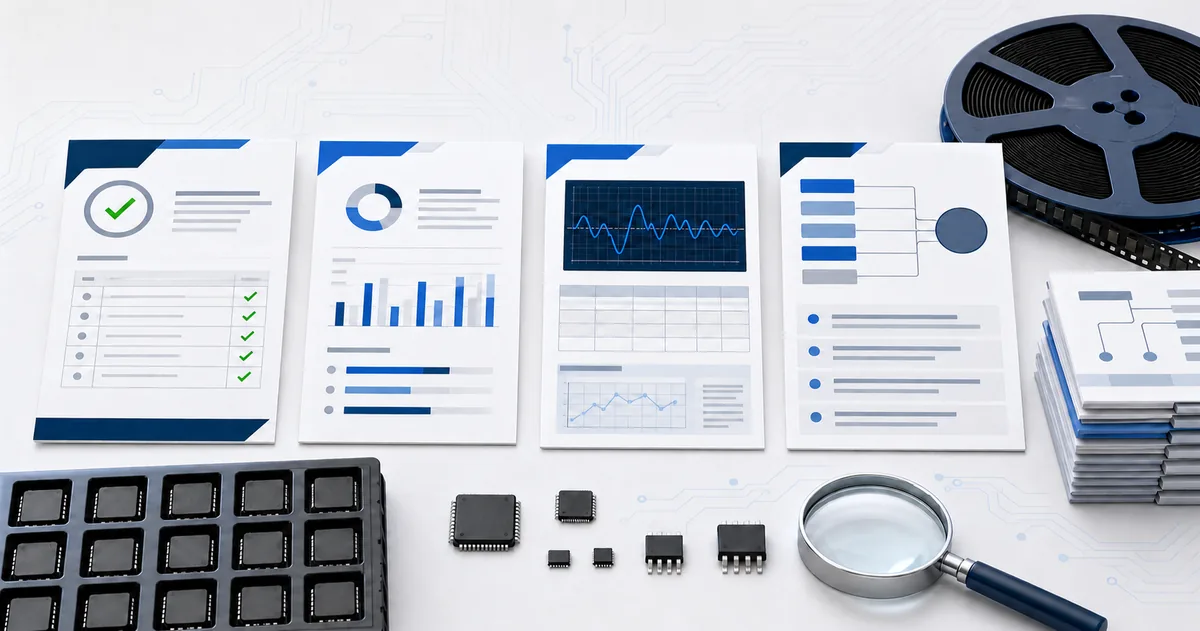
The four records answer different questions. A buyer may need one document or a combined package, depending on the contract, part, sourcing channel, application risk, and customer flow-down requirements.
| Document | Main question answered | Typical evidence | Must link to | Does not prove by itself |
|---|
| Certificate of conformance (COC) | Does the issuer declare that the delivered items meet the stated order or specification? | Signed or authorized conformance statement | Supplier, customer/PO, manufacturer, full part number, quantity, shipment, and lot/date code when applicable | Raw test results, complete chain of custody, or authenticity |
| Certificate of analysis (COA) | What analytical or measured values were reported for the identified material, batch, or lot? | Properties, results, limits, methods, and disposition when applicable | Material or product identity, batch/lot, method, specification, and report date | Source history or proof that every delivered component was tested |
| Test report | What test or inspection was performed, on which samples, by whom, and with what result? | Test method, sample size, observations or measurements, acceptance criteria, and conclusion | Tested samples or lot, part number, date/lot code, test order, and lab/report identity | Untested characteristics, untested units, supply-chain pedigree, or universal authenticity |
| Traceability records | Where did the parts come from, and can the shipment be connected through documented transactions and identifiers? | Purchase orders, invoices, packing slips, manufacturer labels, COCs, shipment records, and custody records | Manufacturer or declared source, intermediaries, part number, quantity, and lot/date/serial identifiers where available | Electrical performance, material composition, or test results |
Do not approve a document from its title alone. Read the statement, identify the issuer, confirm the scope, and verify that the part number and lot or shipment match what you are buying.
What a certificate of conformance tells you
A COC is a declaration. The issuer confirms that the supplied items conform to referenced requirements, such as the purchase order, drawing, specification, or approved product identity. The statement is useful only when those requirements and the covered shipment are clear.
For commercial electronic parts in authorized distribution, the ECIA NIGP 115 guidance lists common COC data elements such as the customer and distributor, purchase order, shipment date, component manufacturer, manufacturer part number, quantity, date code and lot code when provided, and country of origin. It also explains that some manufacturers include conformance language on packing documents rather than issuing a separate manufacturer certificate for every commercial shipment.
"Manufacturer COC," "distributor COC," and "supplier COC" are not automatically equivalent. Name the acceptable issuer in the RFQ and state whether a conformance statement printed on the packing list is acceptable.
What to check on a COC
Legal or trading name of the issuing organization.
Customer name and purchase-order number or line item.
Original component manufacturer and full manufacturer part number.
Quantity and shipment date.
Date code, lot code, serial range, or other identifiers when applicable and available.
Referenced specification, drawing, quality clause, or purchase requirement.
Clear statement of conformance.
Name, title, signature, or controlled electronic authorization.
Revision or issue date.
A COC does not normally provide measured values, and it does not remove the buyer's right or responsibility to inspect. The US Federal Acquisition Regulation COC clause, for example, uses a signed conformance statement with shipment or receiving records while preserving inspection and rejection rights. Commercial contracts vary. The same practical check still applies: the declaration should identify the exact requirements and shipment it covers.
Document availability also varies by product class and sales channel. Texas Instruments' general quality guidance, for example, distinguishes QML documentation from standard shipping documents. Buyers should confirm the required COC type before ordering rather than assuming every catalog component ships with the same certificate.
What a certificate of analysis tells you
A COA reports analytical or measured properties for an identified material, batch, sample, or lot. It is most useful when acceptance depends on values rather than a general declaration.
COAs are common for chemicals, raw materials, reference materials, plating chemistry, adhesives, solders, and other materials whose composition or physical properties require analytical confirmation. They may also appear in component supply chains when a customer specification or manufacturer process calls for them. They are not a universal shipment document for standard catalog semiconductors.
NIST's reference-material program illustrates the core concept: a certificate of analysis reports certified property values and their measurement context for a specific reference material. An electronic component supplier may use the same document name differently, so the buyer must read the scope rather than infer it from "COA."
What to check on a COA
Product or material identity and grade.
Batch, lot, sample, or container identifier.
Specification limits or target values.
Actual results and units.
Test or analytical methods.
Sampling date and report date when relevant.
Laboratory or responsible quality function.
Authorized approval and any stated uncertainty, detection limit, or qualification.
Clear pass/fail or disposition logic when required by the purchase specification.
Ask one question before accepting a COA: does this report cover the item and property you care about? A material-composition COA cannot replace an electrical test report. A report for a source batch cannot be assumed to cover a different finished-component lot. A generic compliance statement with no measured values may be a COC under another name, not an analysis certificate.
What a test report tells you
A test report records a defined inspection or test and its results. Its value depends on five links: the requirement, method, sample, result, and delivered lot. If one link is missing, the report may be informative without supporting shipment acceptance.
The term covers several different records in electronics:
Qualification or reliability summaries for a product family or process.
Lot acceptance or quality conformance data for a defined production lot.
Incoming or pre-shipment inspection reports.
Counterfeit-risk inspection and test reports.
Electrical, functional, X-ray, XRF, solderability, decapsulation, or other method-specific reports.
These records do not have equal scope. A product-family qualification summary may show that a design or process completed specified stresses, but it is not necessarily evidence from the delivered lot. A lot-specific report may cover sampled units rather than every unit. A visual-inspection report cannot support electrical limits that were not tested.
Minimum questions for a test report
Who requested and performed the work?
What standard, method, procedure revision, or customer instruction controlled it?
Which manufacturer part number, lot/date code, serials, or samples were tested?
How many units were received, sampled, tested, and rejected?
What equipment, conditions, and acceptance criteria applied?
Are the actual observations or measured values included, or only a pass/fail conclusion?
Were deviations, anomalies, limitations, subcontracted work, or inconclusive results recorded?
Does the report carry a controlled identifier, issue date, page count, and approval?
When laboratory competence is contractually important, confirm that the relevant method is within the laboratory's scope. ISO/IEC 17025:2017, confirmed current by ISO in 2023, addresses the competence, impartiality, and consistent operation of testing and calibration laboratories. Accreditation to the standard is not a blanket approval of every possible method; the buyer should check the applicable scope and any customer-specific requirement.
For suspect-counterfeit work, SAE AS6171A standardizes risk-based inspection and test procedures for EEE parts with unknown chain of custody. Its scope also makes an important limitation clear: testing may identify anomalies, but authenticity requires known pedigree through an unbroken chain to the original or authorized source. A test report therefore supplements sourcing evidence; it does not manufacture missing pedigree.
What traceability records tell you
In component procurement, traceability records document source and movement. Together, they connect the manufacturer, distributor or other intermediaries, customer order, shipment, part number, quantity, and available date, lot, or serial identifiers. Traceability is usually a record set, not one certificate.
Typical records include:
Manufacturer and distributor packing slips.
Purchase orders and order acknowledgements.
Commercial invoices.
Manufacturer labels and supplier labels.
Certificates of conformance.
Shipping and receiving records.
Lot-split, repackaging, return, or transfer records when those events occurred.
Controlled database records that can be retrieved for customer or audit review.
The evidence should be consistent across records. If a reel label shows one lot, the packing list shows another, and the COC omits the lot entirely, the buyer has a traceability question even if each document looks professional on its own.
Supply-chain traceability is not metrological traceability
The word "traceability" also has a measurement meaning. NIST defines metrological traceability as a property of a measurement result connected to a reference through a documented, unbroken calibration chain. NIST also warns that a test-report number alone is not sufficient proof of that traceability.
| Term | What the chain connects | Typical evidence |
|---|
| Supply-chain traceability | Delivered parts to source, ownership, handling, and shipment events | POs, invoices, labels, packing slips, COCs, custody and inventory records |
| Metrological traceability | A measurement result to a stated reference through calibrations and uncertainty | Calibration certificates, reference standards, method records, measurement uncertainty, laboratory records |
A quality-sensitive RFQ may require both. Supply-chain records help answer where the component came from. Laboratory records help answer whether the reported measurement is technically connected to a valid reference.
Do not treat a date code as a complete traceability chain. The meaning of date and lot markings depends on the manufacturer and product. TI's general quality guidance, for example, states that a date code on some commercial plastic products is used for inventory age control, while a separate manufacturer-defined lot trace code supports lot traceability. Review NTCHIP's guide to electronic component date codes and lot codes before writing a PO restriction based only on a four-digit marking.
Which documents should you request?
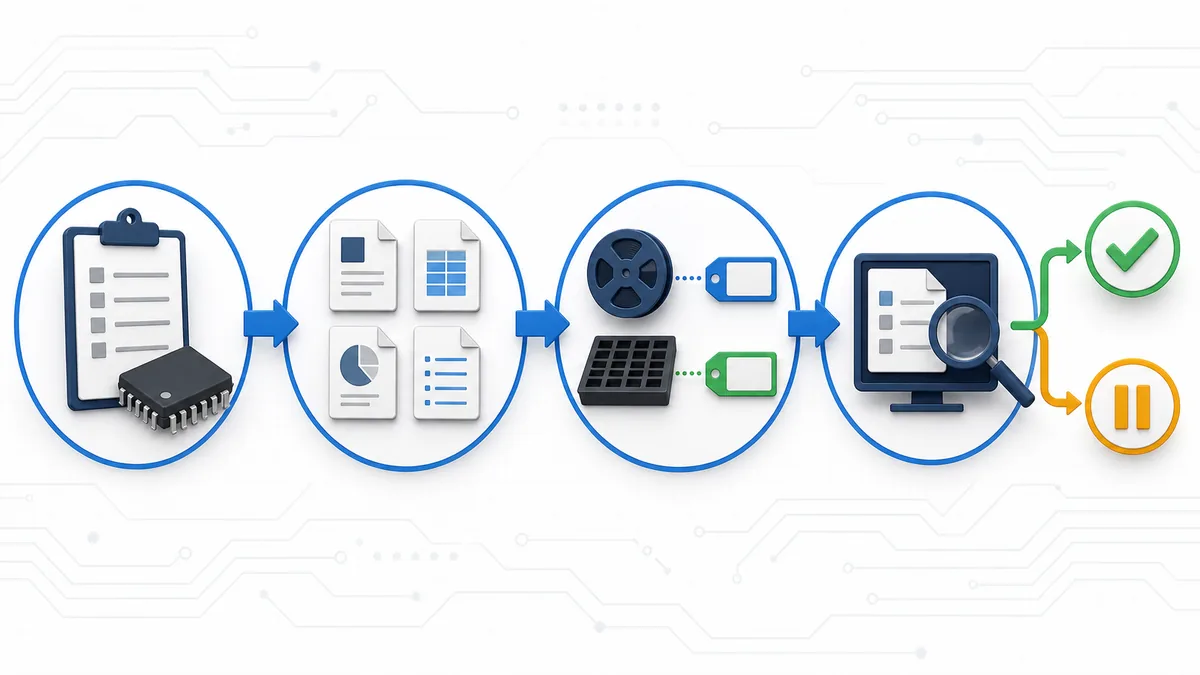
Start with the purchase requirement, not a fixed document bundle. The correct package depends on the customer's flow-down clauses, application risk, component class, source, and whether the evidence must apply to the model, production lot, tested sample, or exact shipment.
| Sourcing scenario | Baseline request to consider | Add when risk or contract requires it | Main caution |
|---|
| Routine commercial part from an authorized channel | Packing list and distributor or manufacturer conformance documentation as specified by the PO | Manufacturer COC, compliance declaration, or retrievable traceability evidence | Do not assume a separate manufacturer COC exists for every commercial line item. |
| Commercial part from an independent source | Supplier COC, source disclosure, available traceability records, labels/photos, and agreed incoming inspection | Risk-based third-party inspection or test report tied to the offered lot | A supplier COC cannot convert an independent source into an authorized one. |
| Obsolete or hard-to-find part with incomplete pedigree | Written disclosure of traceability limits and a documented risk-based inspection/test plan | Method-specific reports, comparison samples, destructive testing, or customer approval where justified | Testing reduces uncertainty but does not recreate an unbroken chain of custody. |
| Military, aerospace, medical, automotive, or customer-controlled purchase | Exact contract, drawing, approved-source, and quality-clause document set | Lot data, manufacturer and distributor certificates, QCI, PPAP, special-process, or laboratory records as flowed down | Use the applicable contract and current standard edition. A generic blog checklist is not sufficient. |
| Material, finish, plating, solder, adhesive, or chemical property requirement | COC plus material declaration or COA tied to the relevant batch | Independent analysis or compliance test report | Confirm that the tested material is the one used for the supplied parts. |
| Qualification or reliability review | Manufacturer qualification summary or product/process report | Lot-specific conformance data when the project requires it | Family-level qualification data may not describe the delivered lot. |
Current standards use different controls for different channels. The SAE page for AS6496 lists AS6496A, issued in 2024, for authorized/franchised distribution. The page for AS6081 lists AS6081A, issued in 2023, for distributors. Verify the edition and exact clauses invoked by the customer's contract before converting either standard into PO language.
Put document requirements in the RFQ and purchase order
Resolve documentation during quotation. State what must be available with the quote, what must ship with the parts, and what may remain on file for later retrieval.
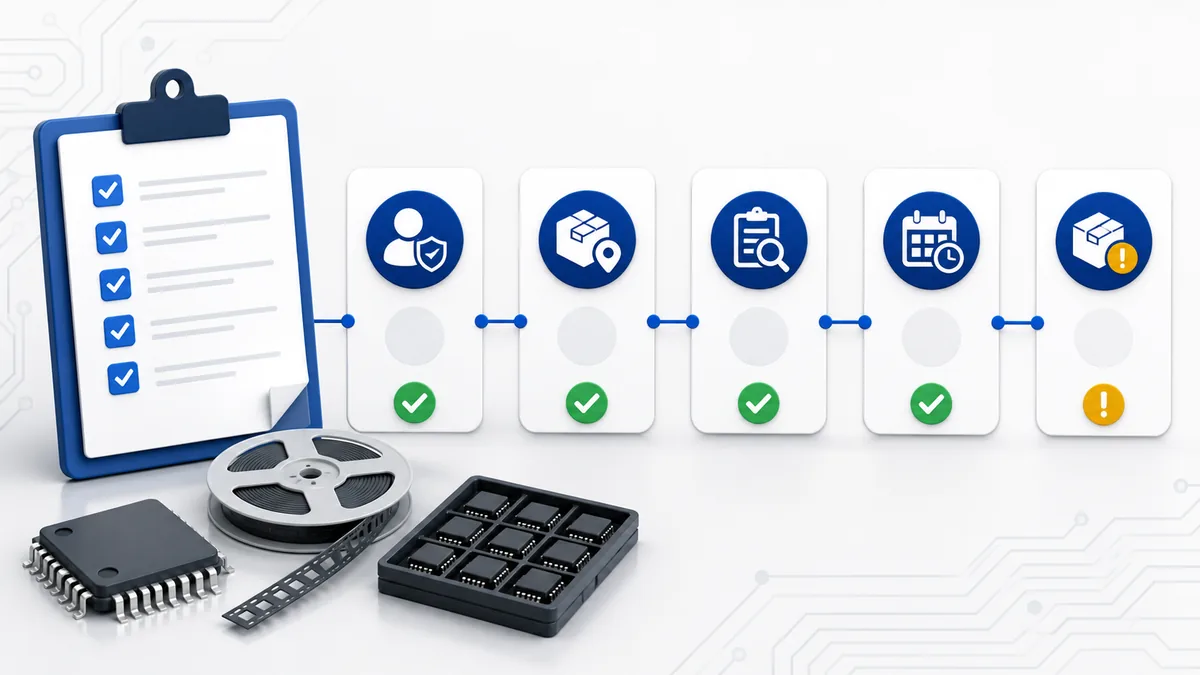
RFQ fields to define
Original component manufacturer and full manufacturer part number.
Package, grade, quantity, and packing format.
Acceptable sourcing channel and any authorization-status disclosure.
Required date-code range, lot restriction, or single-lot requirement, if justified.
Required document type and acceptable issuer.
Whether the document must identify the PO, line item, quantity, date code, lot code, or serial range.
Test or inspection method, sample size, acceptance criteria, report format, and approved laboratory requirements.
Whether destructive testing is permitted and how tested units affect deliverable quantity.
Delivery timing: at quotation, before shipment, with shipment, or on request.
Record-retention and retrieval requirement.
Required action if any record is unavailable or inconsistent.
Copyable RFQ wording
Please confirm document availability before quotation. The quoted parts must be identified by original manufacturer, full manufacturer part number, quantity, package, packing format, and offered date/lot code when available. State the sourcing channel and disclose any limitation in source traceability. Provide or identify the issuer of each required document: [COC / COA / test report / traceability records / other]. Documents must reference the applicable PO line and delivered lot or shipment. For testing, confirm the method, sample size, acceptance criteria, laboratory, report timing, and whether testing is destructive. Do not substitute a supplier declaration for manufacturer documentation or lot-specific test data unless the buyer approves the change in writing.
Adapt this wording to the customer's quality system and contract. Do not paste it into a regulated or safety-critical purchase order without review by the responsible quality, engineering, and contracting functions.
When submitting an NTCHIP request for quote, include these requirements with the part number and quantity. Document availability, inspection scope, pricing, and lead time should be confirmed before purchase.
How to review the document package
Review the records as one evidence set. A document can be genuine and still fail the purchase requirement because it covers the wrong product, lot, method, or issuer.
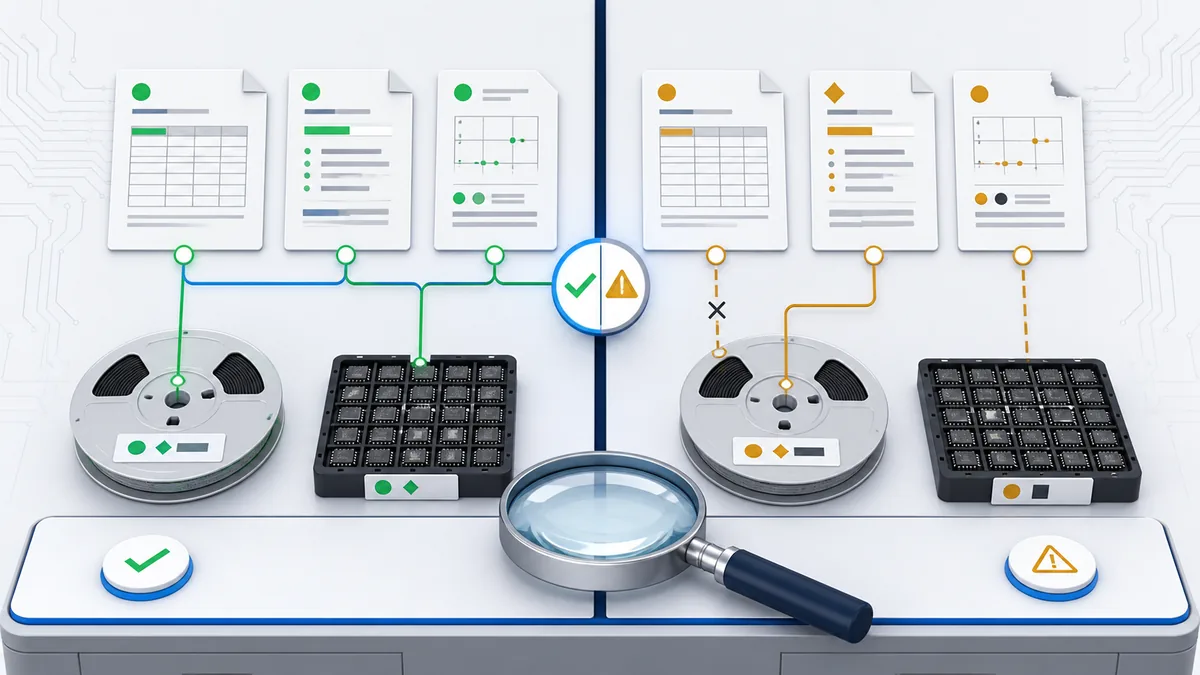
Document review checklist
Match the supplier, customer, PO, and line item.
Match the original manufacturer and full manufacturer part number, including suffixes.
Reconcile quantity, packing format, date code, lot code, serials, and country of origin where required.
Confirm that the issuer is the one specified in the RFQ or PO.
Read the exact conformance statement and referenced specification.
For a COA, compare the reported values, units, methods, and limits with the purchase requirement.
For a test report, confirm sample identity, sample size, procedure revision, acceptance criteria, results, deviations, and disposition.
Check page numbering, attachments, revision, issue date, approval, and controlled report number.
Verify laboratory accreditation and method scope when the contract requires them.
Record any limitation, mismatch, missing link, or supplier clarification.
Save the reviewed package with the receiving and disposition record.
Red flags that need clarification
A generic COC with no PO, shipment, manufacturer, part number, or quantity.
A COA that lists "pass" but provides no property, value, unit, method, or applicable batch.
A test report for a different lot, date code, package, or base part number.
A report that claims 100% testing but lists only a sample and does not explain the scope.
A traceability statement with no retrievable supporting records.
Conflicting manufacturer, part number, quantity, or lot data across labels and documents.
Cropped pages, missing attachments, inconsistent fonts, unexplained edits, or an unverifiable report number.
A claimed standard or accreditation that does not cover the reported method or current contractual edition.
A red flag is a reason to pause and investigate, not automatic proof of misconduct. Preserve the original files, ask the supplier to explain the discrepancy, and document the acceptance or rejection decision.
What to do when a required document is unavailable
Do not solve a document gap by renaming another file. Decide whether the requirement can be changed, supplemented, or must remain a purchase condition.
Confirm the original requirement and why it exists. A customer flow-down or regulated record may be mandatory; an internal preference may allow a risk-based alternative.
Ask what the supplier can provide. A packing-list conformance statement, manufacturer portal record, or retrievable traceability file may meet the actual need even if the file name differs.
Check the linkage. Alternative evidence still needs to match the offered source, part, quantity, and lot or shipment.
Assess whether inspection or testing addresses the missing evidence. Testing can answer defined technical questions, but it cannot replace chain-of-custody records.
Obtain written approval for any deviation before ordering. Record the approver, scope, alternative evidence, and receiving action.
If the gap is unresolved, do not represent the document as available. Change the source, change the requirement through an authorized process, or stop the purchase.
At receiving, hold or quarantine a lot when a mandatory document is missing or inconsistent. Use the incoming inspection checklist to record the mismatch and disposition instead of allowing undocumented parts to enter stock or production.
How NTCHIP can support document-aware RFQs
NTCHIP can help buyers organize electronic component sourcing requirements before quotation. Send the manufacturer, full part number, quantity, package, target date, acceptable sourcing channel, date/lot restrictions, and required documentation.
The inquiry should also state whether you need a supplier or manufacturer COC, a COA for a defined property, a method-specific test report, source traceability records, or a customer-specific data pack. For higher-risk or obsolete parts, describe the inspection scope and approval process rather than asking for unspecified "full testing."
NTCHIP can review the request and identify items that need supplier confirmation. Confirm document availability, source information, inspection scope, pricing, and lead time through RFQ. No document or test should be treated as a universal guarantee of authenticity or application suitability.
Conclusion
Use document names as a starting point, then verify the evidence. A COC declares conformance. A COA reports analytical or measured values. A test report records defined work on identified samples. Traceability records connect the shipment to its source and transaction history.
A usable purchase requirement names the issuer, required fields, covered lot or shipment, and delivery timing. Put those details in the RFQ and PO, then check the same links at receiving.
To discuss documentation for an electronic component inquiry, request a quote from NTCHIP with the manufacturer, full part number, quantity, target date, sourcing constraints, and required records. Availability, pricing, lead time, document availability, and inspection scope should be confirmed before purchase.
FAQ
Is a COC the same as a COA?
No. A COC is primarily a declaration that supplied items conform to referenced requirements. A COA reports analytical or measured values for an identified material, batch, sample, or lot. Suppliers may use the terms differently, so verify the content and scope.
Does a COC include test results?
Usually not. A COC may refer to inspection or quality-system controls, but it normally provides a conformance statement rather than raw measurements. Request a lot-specific test report or data pack when measured results are required.
Is a COA required for electronic components?
Not for every component. A COA is relevant when the contract or product requires analytical or measured batch data, such as material or chemical properties. Standard catalog semiconductors may use other quality and reliability documents. Confirm availability and applicability before ordering.
Can a test report replace traceability records?
No. A test report records defined work on identified samples. Traceability records document source, ownership, and shipment history. Testing can reduce technical uncertainty, but it cannot recreate a missing chain of custody.
Does a date code prove full traceability?
No. A date code can identify a manufacturing period or support a manufacturer's tracking system, but its meaning varies. Full traceability depends on the manufacturer's identifiers and consistent transaction, label, and shipment records.
What is the most important RFQ requirement?
Require every document to identify what it covers. State the acceptable issuer, part number, quantity, lot/date/serial linkage, method or specification, delivery timing, and action if the record is unavailable.
Does a COC or test report prove that a component is authentic?
Not by itself. A COC is a declaration, and a test report is limited to the samples, methods, and acceptance criteria stated. Known source pedigree and consistent chain-of-custody records provide stronger authenticity evidence; risk-based testing may supplement that evidence.