
A date code is evidence, not a verdict. Electronic component date codes refer to manufacturer-defined production periods or process events, while lot codes identify manufacturer-defined production groups or trace records.
These codes help procurement and quality teams review date-range requirements, lot separation, documents, and receiving discrepancies. Misreading a format can lead a buyer to accept material outside the purchase requirement or reject a conforming shipment.
Start with the exact manufacturer, full orderable part number, package, and code location. Then compare the applicable manufacturer guidance with the device markings, original labels, shipment documents, packaging and storage evidence, lifecycle records, and purchase order.
Quick answer: how date codes and lot codes work
An electronic component date code is a manufacturer-defined code tied to a manufacturing-related time period. A lot code is a batch or genealogy key assigned by the manufacturer. The two fields may appear together or one may be embedded in the other, but they do not answer the same question. A date code is not an expiration date and does not, by itself, establish a component's remaining usable life.
A four-digit code such as 2417 may mean year 2024, work week 17 under a documented YYWW convention. Do not apply that reading until the manufacturer, product family, package, code location, and marking guide confirm it. Other products use YWW, year-month characters, calendar dates, or trace strings that only the manufacturer can resolve.
Use this five-step rule:
Confirm the original manufacturer and full orderable part number, including package and suffix.
Record whether the code came from the device, reel, tube, tray, bag, box, packing slip, or certificate.
Find the manufacturer's current datasheet, package-marking guide, or quality document.
Compare the quote and PO with the shipping documents, original container labels, and device markings.
Resolve unexplained differences before accepting, kitting, or assembling the lot.
Interpret any decoded date with the manufacturer's marking rules, lot information, original shipping records, packaging condition, lifecycle history, and the buyer's stated requirements.
Date code vs. lot code: the practical difference
A date code groups material by a manufacturer-defined time reference. A lot code groups or identifies material through the manufacturer's production and trace records. Some manufacturers call the latter a trace code, lot trace code, batch code, or genealogy code.
| Question | Date code | Lot code or trace code |
|---|
| Primary purpose | Identifies a manufacturing-related date or period | Identifies a manufacturer-defined production grouping or record key |
| Typical form | YYWW, YWW, year-month characters, calendar date, or an embedded field | Manufacturer-specific letters and numbers; it may also contain date or site characters |
| Publicly decodable? | Sometimes, when the marking guide defines it | Often only partly; the manufacturer may need to resolve the record |
| Unique to one production lot? | Not necessarily | Intended for lot or genealogy tracking, but the trace depth depends on the manufacturer's records |
| Main buyer use | Check chronology, age requirements, and consistency across records | Segregate material, investigate a quality issue, and request lot-level evidence |
| What it cannot prove alone | Condition, authenticity, storage history, or usable life | Full chain of custody, authenticity, or compliance with the PO |
The distinction matters during both sourcing and failure investigation. Two parts can share the same date code and come from different lots. A shipment can also contain more than one date or lot when the manufacturer's policy and the buyer's order allow it.
A lot code becomes useful when the original manufacturer or another responsible record holder can connect it to production, test, packaging, or shipment records. Without those records, the printed string does not establish complete traceability.
Common date-code formats are examples, not a universal decoder
YYWW appears often, but the marking guide still has to confirm it. Formats can change across manufacturers, product families, packages, sites, and production eras. The code may describe assembly, sealing, mark-and-pack, or another defined stage rather than one universal "manufacturing date."
The examples below are illustrative only:
| Possible structure | Example | Safe interpretation |
|---|
| YYWW | 2417 | May mean 2024, work week 17 when the product's marking guide defines YYWW |
| YWW | 417 | May mean a year ending in 4, week 17; the decade needs independent evidence |
| Year-month plus trace or site characters | 4B… | The year, month character, lot, and site positions must come from the manufacturer's convention |
| Calendar date embedded in a lot field | 101324… | May encode a month, day, and year for a named manufacturer field; do not generalize it |
| Opaque trace string | A7K29Q | May be resolvable only through the manufacturer or an official trace record |
A Microchip package-marking example for AT88SCxxxxCA CryptoMemory low-density devices defines YY and WW for the SOIC marking while directing users to contact Microchip to resolve the assembly year and week from the UDFN trace code. The example is product- and package-specific: package space and marking practice can change what the buyer sees.
For the Flash products covered by Infineon KBA238306, the package-assembly date appears as YYWW on shipment records, while a later mark-and-pack date appears as YWW on the device. Within that documented scope, a top mark and a shipping label can differ without being contradictory.
Before decoding any string, identify four things: the exact part, the package, the place where the code appears, and the manufacturing event the document assigns to it. If one of those is unknown, record the interpretation as unresolved rather than forcing the code into a familiar pattern.
Where to find the codes and which records to compare
Start with identity, not the code. Confirm the original component manufacturer, full orderable part number, package, grade, and packing format. A shortened family name or top-mark code may point to several orderable variants.
Date and lot information can appear at several levels:
| Evidence source | Typical scope | What it can add | Limitation to check |
|---|
| Device top or underside marking | Individual device | Part identifier, date or trace characters, site or revision fields | Small packages use abbreviated markings, and the date field may sit on the underside or be folded into a trace string |
| Reel, tube, tray, bag, or carton label | Container | Fuller MPN, quantity, lot/date fields, packing data, moisture sensitivity level (MSL), and a shipment or trace identifier | Confirm whether it is the original manufacturer label, an authorized channel label, or a later supplier/repack label |
| Moisture barrier bag (MBB) and handling labels | Packaged moisture-sensitive material | Seal or rebag information, MSL, humidity indicator card (HIC)/desiccant context, and exposure controls | A bag date is not necessarily the device manufacturing date |
| Packing slip, certificate of conformance (CoC), or inspection record | Shipment or order line | Declared lot/date groupings, quantities, source statements, and agreed inspection results | The document may summarize several containers or rely on upstream information |
| Manufacturer trace response or official quality record | Manufacturer-defined lot or shipment record | Can resolve an opaque trace code and explain site, stage, or lot relationships | Access and trace depth vary; the manufacturer may need the original label or shipment identifier |
| Quote, PO, and approved deviation | Commercial requirement | Defines what the buyer ordered and which differences were accepted | It states the requirement; it does not prove the delivered evidence is correct |
These sources complement one another. The top mark may be the closest record to an individual device, while the original container label may hold the fuller trace field needed to interpret it. The packing slip may then show how several containers were grouped for shipment.
A literal character-for-character match is useful only after the team knows what each field represents. A package-assembly date, a mark-and-pack date, and a bag seal date can all be valid and different. The review should establish whether the records reconcile under the manufacturer's documentation and the buyer's requirement.
How to verify date codes and lot codes step by step
Use the same evidence process before purchase and at receiving. Before purchase, work from supplier photos and documents. At receiving, preserve the physical packaging so the team can compare what arrived with what was quoted.
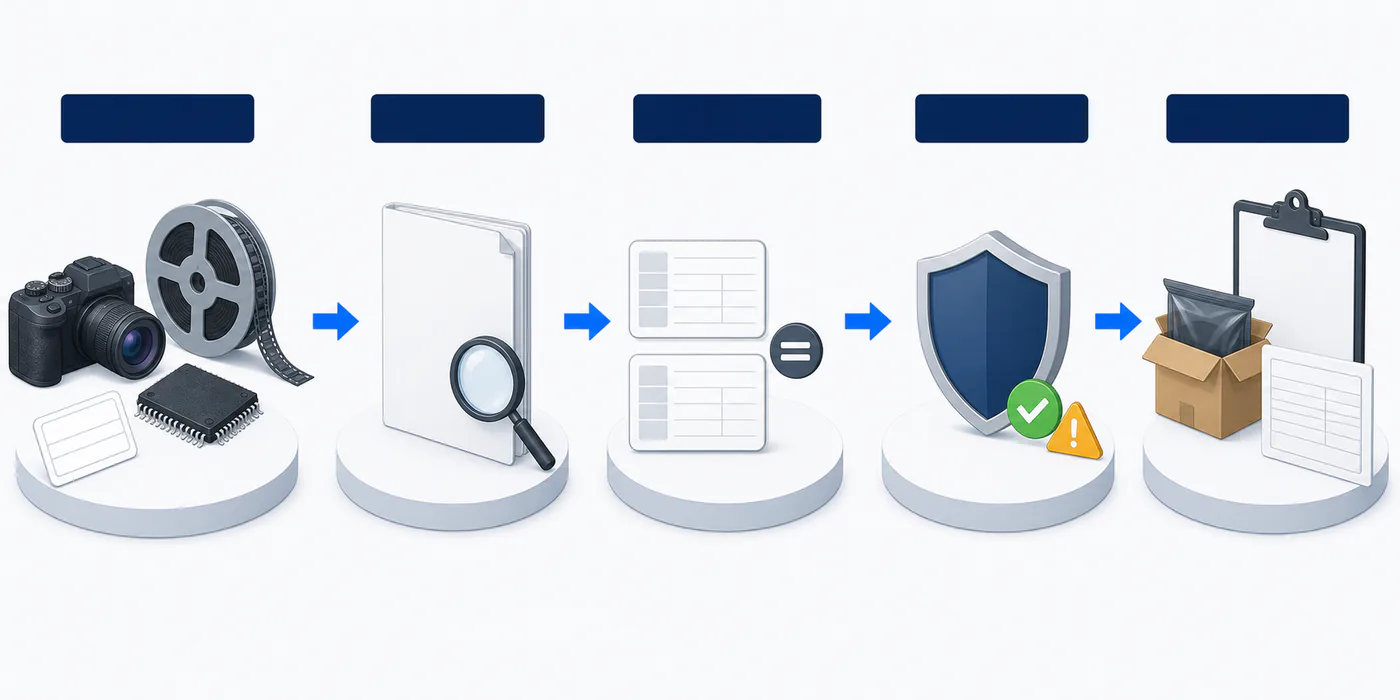
Capture the physical evidence, check the manufacturer rule, compare records, resolve risk, and document the buying or receiving decision.
Normalize the part identity. Record the original manufacturer, full orderable MPN, suffixes, package, grade, terminal finish when relevant, and packing format. Do not decode a marking against a family name alone.
Capture every code in context. Photograph the device top and underside where practical, plus the full reel, tube, tray, bag, and carton labels. Keep each code attached to its source and quantity.
Find the official convention. Use the current datasheet, package-marking guide, quality document, or product-specific manufacturer support record. Record the document title, revision, URL, and review date.
Identify the field and event. Determine whether the string is a date code, lot trace code, ship trace code, bag seal date, rebag date, or another field. Confirm whether it refers to assembly, seal, mark-and-pack, or a different stage.
Compare the commercial and physical records. Review the RFQ, quote, PO, packing slip, CoC, approved deviations, original container labels, and device markings. Count the quantity associated with each date and lot group.
Resolve ambiguity in writing. Ask for clarification when the decade is unclear, a trace string is opaque, codes are mixed, the part was repacked, or two records cannot be reconciled. Keep the response with the receiving or purchase record.
Assign a disposition. Apply the buyer's approved procedure and record Accept, Hold, Quarantine, or Reject. Do not move unresolved material into stock, kitting, or assembly.
Keep a compact evidence log:
| Field | Record |
|---|
| Manufacturer and full MPN | Exact orderable identity and package |
| Code source | Device, underside, reel, tray, tube, bag, carton, packing slip, or CoC |
| Code as observed | Exact characters; attach an uncropped photo |
| Claimed meaning | Date, lot, trace, seal, rebag, site, or other field |
| Official reference | Manufacturer document, revision, URL, and date checked |
| Quantity | Units associated with each code or lot |
| Difference found | What does not reconcile and why it matters to the PO |
| Resolution and disposition | Written clarification, deviation, inspection, Accept, Hold, Quarantine, or Reject |
A saved evidence record is more useful than a decoded year written in an email. It lets another buyer or quality reviewer reconstruct the decision later.
What the codes can prove, and what they cannot
Use date and lot codes as one part of the evidence review.
| The codes can help you | The codes cannot prove by themselves |
|---|
| Group material by a declared time period or lot | That the component is authentic |
| Compare a visible marking with the manufacturer's documented convention | That the part meets electrical specifications |
| Reconcile devices with original container and shipment records | How the material was stored or handled |
| Segregate lots during receiving, production, or a quality investigation | Remaining floor life, solderability, or usable life |
| Identify a chronology that needs manufacturer or supplier clarification | Current lifecycle status or replacement compatibility |
| Provide a key for a party that holds the underlying trace records | An unbroken chain of custody or compliance with every PO requirement |
Escalate a review when:
the confirmed format produces an impossible or unexplained date;
the date appears inconsistent with the manufacturer's documented production or discontinuance timeline;
a container label, device mark, packing slip, and CoC cannot be reconciled after accounting for different manufacturing stages;
a shipment quoted as one lot contains several lot codes;
labels appear replaced, altered, incomplete, or detached from the quantity they describe;
devices presented as one homogeneous lot have unexplained differences in marking format, surface, package, or code structure.
These are investigation triggers, not automatic counterfeit findings. A date after a published discontinuance, for example, may require checking final production, final shipment, packaging, and record dates before a conclusion is made.
Marking review should sit inside the buyer's broader quality-control process. When the evidence justifies a suspect-parts review, use a risk-based process to identify counterfeit electronic components rather than relying on a date decoder, visual check, or solvent wipe as proof.
How to evaluate older date codes without an arbitrary freshness rule
There is no universal age limit for electronic components. An older manufacturing date does not, by itself, show that a part is defective, obsolete, or counterfeit. A recent date does not prove that storage and handling were acceptable.
Manufacturer policy matters. Texas Instruments' product shelf-life guidance states that, for TI products managed under TI's processes, minimum useful life is based on delivery rather than manufacturing date. TI also directs customers to consider MSL, moisture-barrier packaging, desiccant, humidity indicator cards, and storage conditions.
Analog Devices' Date Code Policy says ADI may ship products with date codes up to five years old. This is an ADI policy, not a five-year acceptance rule for every manufacturer or component category.
Use the following questions to build a part-specific decision:
| Review area | Evidence to check | Procurement or quality decision |
|---|
| Manufacturer policy | Current shelf-life, storage, marking, and handling documents for the exact product | Apply the manufacturer's rule without extending it to other brands or product families. |
| Contract requirements | RFQ, quote, PO, customer specification, and approved deviations | A contractual date limit controls even when the manufacturer permits older material. |
| Moisture protection | MSL, MBB condition, seal or rebag date, HIC, and desiccant where applicable | Decide whether the packaging evidence supports release, further review, or manufacturer-defined conditioning. |
| Storage and handling | Available storage records, environmental exposure, and chain-of-custody information | Treat missing or conflicting evidence according to the buyer's risk and quality procedure. |
| Physical condition | Package integrity, terminal condition, corrosion, contamination, and label condition | Define any inspection or solderability requirement before acceptance. |
| Component technology | Manufacturer guidance for the exact semiconductor, passive, relay, battery, or other device type | Do not apply semiconductor storage conclusions to unrelated technologies. |
| Lifecycle status | Current lifecycle evidence, PCN/EOL notices, and sourcing context | Expect older dates when sourcing legacy material; a recent-date rule may exclude the only valid production period. |
| Application risk | Assembly process, field environment, customer requirements, and qualification controls | Apply stricter evidence or testing requirements where the application or contract calls for them. |
Obsolete material may carry an older date code because production ended years ago. Buyers handling that situation should source obsolete electronic components safely and evaluate lifecycle evidence, packaging, storage, documentation, and application risk together.
Use age to decide what evidence, inspection, testing, or supplier clarification is needed. If the available evidence cannot support the required decision, hold the material before use.
Single-lot, mixed-lot, and mixed-date-code shipments
Mixed date codes or lot codes are not automatically abnormal. The correct response depends on the manufacturer's policy, the meaning of each code, and the requirements accepted in the purchase order.
For example, Analog Devices' Date Code Policy permits multiple seal date codes in certain shipping media: up to three per reel, two per tube, and three per tray stack. It also states that shipments may contain multiple manufacturing lots. Those rules apply to the ADI products covered by that policy; they are not industry-wide limits.
| Scenario | What it may mean | Buyer action |
|---|
| One date code and one lot code | The material appears grouped by both time field and lot identifier. | Confirm the code definitions and compare them with the labels and documents. |
| One date code with several lot codes | Several manufacturing lots share the same visible time period. | Do not treat the common date code as proof of a single lot. Record quantities by lot. |
| Several date codes in one original reel, tube, or tray | The manufacturer may permit mixed seal or production dates in that medium. | Check the applicable manufacturer policy and the PO before accepting the mix. |
| Several lots or dates across a shipment | The order may have been filled from more than one production grouping. | Keep each group identified and confirm whether mixed supply was permitted. |
| Mixed material against an agreed single-lot or date-range requirement | The shipment may be contractually nonconforming even if the manufacturer normally permits mixing. | Hold the affected material and obtain a documented disposition or approved deviation. |
| Unexplained codes, altered labels, or inconsistent markings | The records do not yet support the declared lot structure. | Quarantine the material and investigate. Do not make an automatic counterfeit finding from the mismatch alone. |
"Single date code," "single manufacturing lot," and "homogeneous lot" are not interchangeable. If separation matters, define the required grouping, request quantities by lot and date code, and state how each group must be labeled.
Put the requirement into the RFQ and purchase order
Date-code disputes can begin with an undefined request such as "recent date code." Replace that wording with a measurable preference or acceptance condition before asking for a quote.
| RFQ or PO field | What to provide |
|---|
| Manufacturer and part number | Manufacturer name and full orderable MPN, including every suffix. |
| Product configuration | Package, grade, terminal finish, and packing format. |
| Commercial need | Quantity and required or target delivery date. |
| Date-code rule | State whether the range is preferred or mandatory. Define the permitted years, work weeks, maximum age, or another manufacturer-supported field, and give the technical or contractual reason. |
| Lot rule | State whether mixed lots are accepted or whether the order requires one date code, one manufacturing lot, or another clearly defined grouping. |
| Quantity disclosure | Ask for the quantity associated with each date code and lot code when separation matters. |
| Packaging evidence | Specify original-packaging needs and whether preshipment photos of device markings, reels, trays, tubes, bags, or carton labels are required. |
| Documents | List any required CoC, traceability, compliance, MSL, storage, or test records. |
| Inspection and testing | Define the inspection scope, sampling plan, test method, and acceptance criteria that apply to the order. |
| Deviations | Require written approval before shipment when an offered date, lot, packing, document, or inspection condition differs from the PO. |
| End-use constraint | Identify customer, application, regulatory, or contractual requirements that affect acceptance without disclosing unnecessary confidential information. |
The following clause is a starting point for the buyer's quality and purchasing teams to adapt:
Quote [manufacturer] [full MPN], [package/grade/finish], in [packing format],
quantity [quantity].
Date-code requirement: [no restriction / preferred range / mandatory range],
based on [technical, customer, or contractual reason].
Lot requirement: [mixed lots accepted / single date code / single manufacturing
lot / other defined grouping]. Before shipment, disclose each date code and lot
code with its quantity and provide [required photos and documents].
Do not deviate from mandatory date-code, lot, packing, documentation, or
inspection requirements without written buyer approval.
Match the terminology to the manufacturer's records and the buyer's quality system. A preferred range allows the supplier to quote an alternative for review; a mandatory range becomes an acceptance condition.
Send these details when you request a quote. Availability, code range, lot structure, documentation, inspection options, price, and lead time remain subject to confirmation for the exact part and source.
What to do when the shipment arrives
Receiving inspection should verify the shipment against the requirement agreed before purchase.
Preserve the original labels, bags, reels, tubes, trays, and cartons. Photograph markings and labels before opening or separating the material.
Segregate and count the material by visible date code and lot code. Do not combine groups before the review is complete.
Compare the quote, PO, packing slip, CoC, approved deviations, container labels, and device markings. First determine what each field means; do not require a character-for-character match between unrelated fields.
Where relevant, review the MBB seal or rebag information, HIC, desiccant, MSL marking, packaging integrity, and physical condition under the applicable manufacturer guidance.
Record the evidence and apply the buyer's approved disposition: Accept, Hold, Quarantine, or Reject.
Keep unexplained differences out of kitting and assembly until quality personnel complete the required clarification, inspection, or testing.
The incoming inspection checklist for electronic components covers the broader receiving process, including identity, packaging, documentation, visual inspection, sampling, and escalation.
How NTCHIP can support a code-sensitive RFQ
NTCHIP can review date-code and lot-code requirements as part of an electronic component sourcing request. Provide the manufacturer, full MPN, package, quantity, packing format, acceptable code range, lot rule, required documents, and inspection scope.
State whether each condition is preferred or mandatory and whether a deviation needs written approval. Exact availability, date-code range, lot structure, original documentation, inspection options, pricing, and lead time must be confirmed for the specific inquiry.
Any resulting offer should still be reviewed against the buyer's PO, application requirements, and quality procedure before purchase.
FAQ
What does a four-digit code such as 2417 mean?
The code 2417 may mean 2024, week 17 when the applicable manufacturer document defines the field as YYWW. That interpretation is not universal. The same characters could follow another convention or form part of a longer trace string. Confirm the manufacturer, full MPN, package, code location, and current marking guide before using the code in an acceptance decision.
Is a lot code the same as a date code?
No. A date code identifies a manufacturer-defined time period or manufacturing stage. A lot code identifies a production grouping or genealogy record. A lot code may contain a date, but the fields are not interchangeable. Several lots can share one date code, and one shipment can contain several date codes or lots.
Does an old date code mean the component has expired, is obsolete, or is counterfeit?
No. A date code is not an expiration date. Manufacturing age, remaining usable life, lifecycle status, authenticity, and condition are separate questions. An older code may be normal for legacy material, while an active part may also come from stored inventory. Review manufacturer policy, lifecycle records, packaging, storage evidence, physical condition, documents, and application requirements. An old code alone does not prove that a component has expired, is bad, or is counterfeit.
Can the same reel contain multiple date codes?
Yes, when the manufacturer permits it. Analog Devices, for example, allows a defined number of seal date codes in certain reels, tubes, and tray stacks under its published policy. Another manufacturer may use different rules. A permitted mix can still violate a purchase order that requires one date code or one manufacturing lot, so check both sources before acceptance.
Can date codes and lot codes prove authenticity?
No. Plausible codes can support chronology, record matching, and anomaly review, but they cannot prove authenticity by themselves. They also do not establish electrical performance, storage history, solderability, lifecycle status, or an unbroken chain of custody. Compare official marking guidance, packaging labels, supplier records, shipment documents, and any inspection or test evidence required by the buyer's quality procedure.
Where should a buyer find the official decoding rule?
Start with the current manufacturer datasheet, package-marking guide, quality document, or product-specific support page for the exact MPN and package. Container labels may provide fuller trace fields than the device marking. If the code is opaque or the documents conflict, request written clarification from the manufacturer or supplier. Treat a generic online decoder only as a hypothesis.
Should date-code requirements be included in an RFQ?
Yes, when age or lot structure affects the application, customer specification, assembly process, or contract. State the acceptable range, whether it is preferred or mandatory, and whether mixed date codes or lots are allowed. Also define packaging, document, photo, inspection, test, disclosure, and deviation requirements. This gives the supplier enough information to confirm what can be offered before purchase.
Turn code evidence into a documented buying decision
Use the correct manufacturer rule to read electronic component date codes. Judge older material with packaging, storage, component technology, lifecycle status, application risk, and contract requirements. Then put the accepted date range, lot structure, documents, and inspection criteria into the RFQ and PO.
For a part-specific sourcing review, send NTCHIP the manufacturer, full MPN, package, quantity, code and lot requirements, and required evidence. Availability, pricing, lead time, code selection, lot structure, and documents must be confirmed through RFQ.